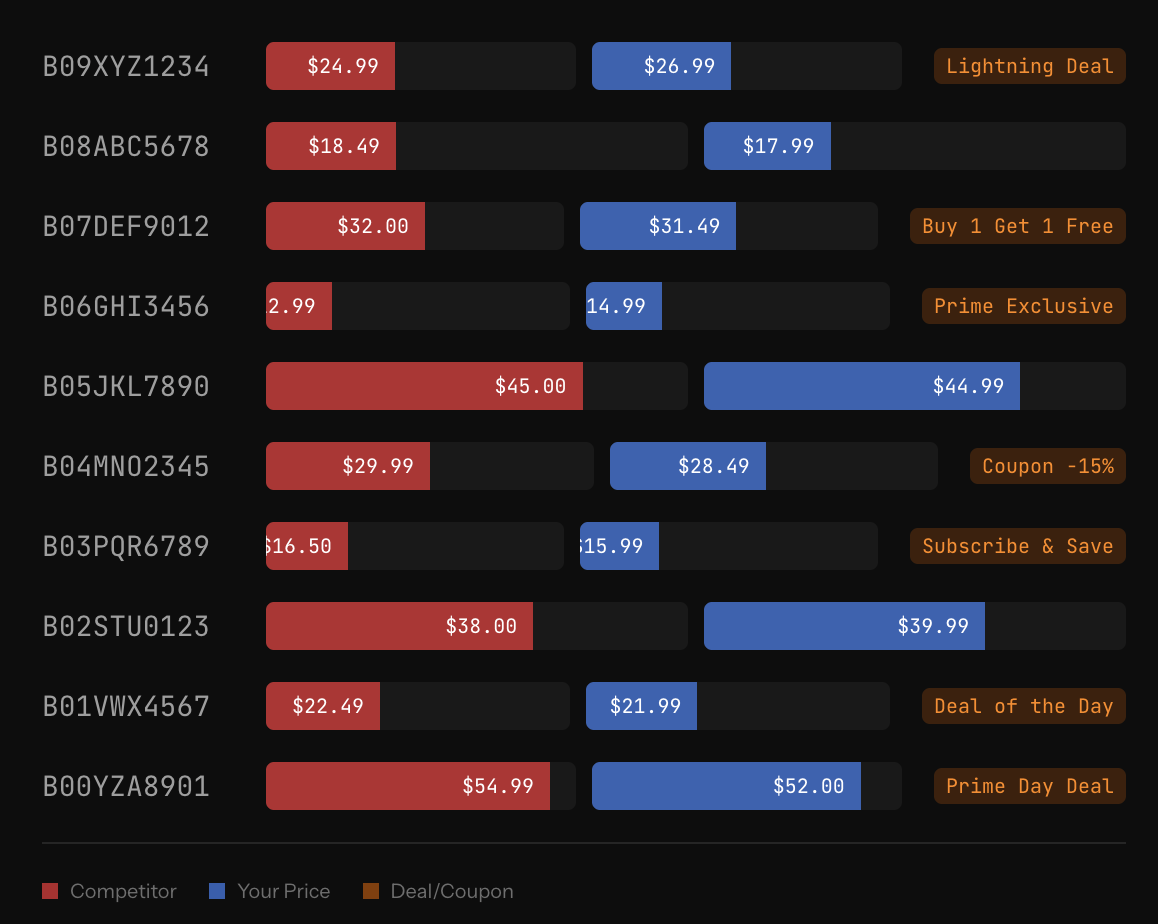
Price on Amazon is not a number you set once. It is a variable that changes in response to competitor moves, promotional events, inventory levels, and algorithmic repricing — often multiple times per day. For any seller trying to maintain Buy Box position or protect margin, understanding what competitors are charging at any given moment is a baseline operational requirement.
The problem is that manual price checks do not scale. Checking 50 competitor listings across 100 ASINs even twice a day is 10,000 data points — before accounting for the deals and coupons that modify effective price without changing the listed price.
Listed price vs effective price
This distinction is critical and often missed. A competitor can list a product at your MAP floor while running a 20% coupon that brings the effective customer price significantly below it. Amazon displays the post-coupon price prominently in search results and on the product page — which means your listed price comparison is misleading.
Effective price monitoring requires pulling both the listed price and any active promotions for each seller offer. Asgard's offers endpoint returns current price data for all active sellers on a listing. The promotions endpoint returns active deals including coupon values, Lightning Deal pricing, and Prime Exclusive discounts. Together, these give you the true effective price each competitor is charging right now.
Deal types to monitor
Not all promotions have the same competitive impact:
- Lightning Deals — Time-limited, high-visibility deals that appear in dedicated sections and drive a significant volume spike. These can move Buy Box position within minutes of going live and typically last 4–12 hours.
- Prime Exclusive Discounts — Visible to Prime members in search results with a strikethrough price. These run continuously until removed and have a persistent effect on competitive positioning.
- Coupons — Shown as a green badge in search results. They reduce effective price but require customer action to clip. The competitive impact is lower than Lightning Deals but persistent.
- Subscribe and Save — Creates a recurring price reduction for subscribed customers. Monitoring this is critical for consumable categories where S&S penetration drives long-term market share.
- Deal of the Day — Homepage featured deal with very high traffic. If a competitor wins this slot, expect a significant volume spike and potential rank gains that persist after the deal ends.
Building a price and deal monitoring pipeline
An effective monitoring pipeline has three components:
- Continuous price polling — Pull current prices for all tracked competitor ASINs on a defined cadence. For high-velocity categories, hourly is appropriate. For slower categories, every 4–6 hours may suffice.
- Deal detection — Poll the promotions endpoint to detect when a competitor activates a Lightning Deal, coupon, or Prime Exclusive. This should trigger an immediate alert rather than waiting for the next scheduled poll.
- Automated response rules — Define what your system should do when specific events are detected. Common rules include: match effective price within margin floor when competitor Lightning Deal goes live, adjust PPC bids when a competitor runs a Prime Exclusive, flag for manual review when a new unauthorized seller appears below MAP.
The margin protection layer
Automated price response is powerful but requires guardrails. A repricing system without floor and ceiling rules will follow competitor prices into margin destruction. Every automated response rule should have a floor — the minimum price at which you are willing to sell — and the system should alert rather than act if a competitor move would require pricing below that floor.
The goal of price monitoring is not to always match the lowest price. It is to make informed decisions about when to compete on price, when to hold position, and when a competitor move signals an underlying change (new supplier, liquidation, supply chain issue) that requires a strategic rather than tactical response.
Real-time data is what separates reactive pricing from strategic pricing. The infrastructure to collect it at scale is what Asgard provides.