The Amazon Buy Box is the most valuable piece of real estate in e-commerce. Roughly 83% of Amazon sales go through it — and for mobile shoppers, that number is even higher. Yet most sellers still treat Buy Box eligibility as a mystery rather than a data problem.
It is a data problem. And it is solvable.
What actually determines Buy Box eligibility
Amazon has never published its exact algorithm, but years of observed data point to a consistent set of factors:
- Fulfillment method — FBA and SFP sellers get a built-in advantage because Amazon controls the delivery experience. FBM sellers can compete, but only if their shipping times are genuinely competitive.
- Seller metrics — Order defect rate, late shipment rate, and cancellation rate all feed into eligibility. If any of these exceed Amazon's thresholds, you lose Buy Box access regardless of price.
- Price — Not just your price, but your landed price including shipping. Amazon compares total cost to the customer across all eligible sellers.
- Shipping time promise — Expected delivery date matters more than price in many categories. A seller promising 2-day delivery will beat a seller with a lower price promising 7 days.
- In-stock rate — Stockouts directly reduce Buy Box share. Amazon favors sellers that reliably have inventory available.
How to use state-level Buy Box data
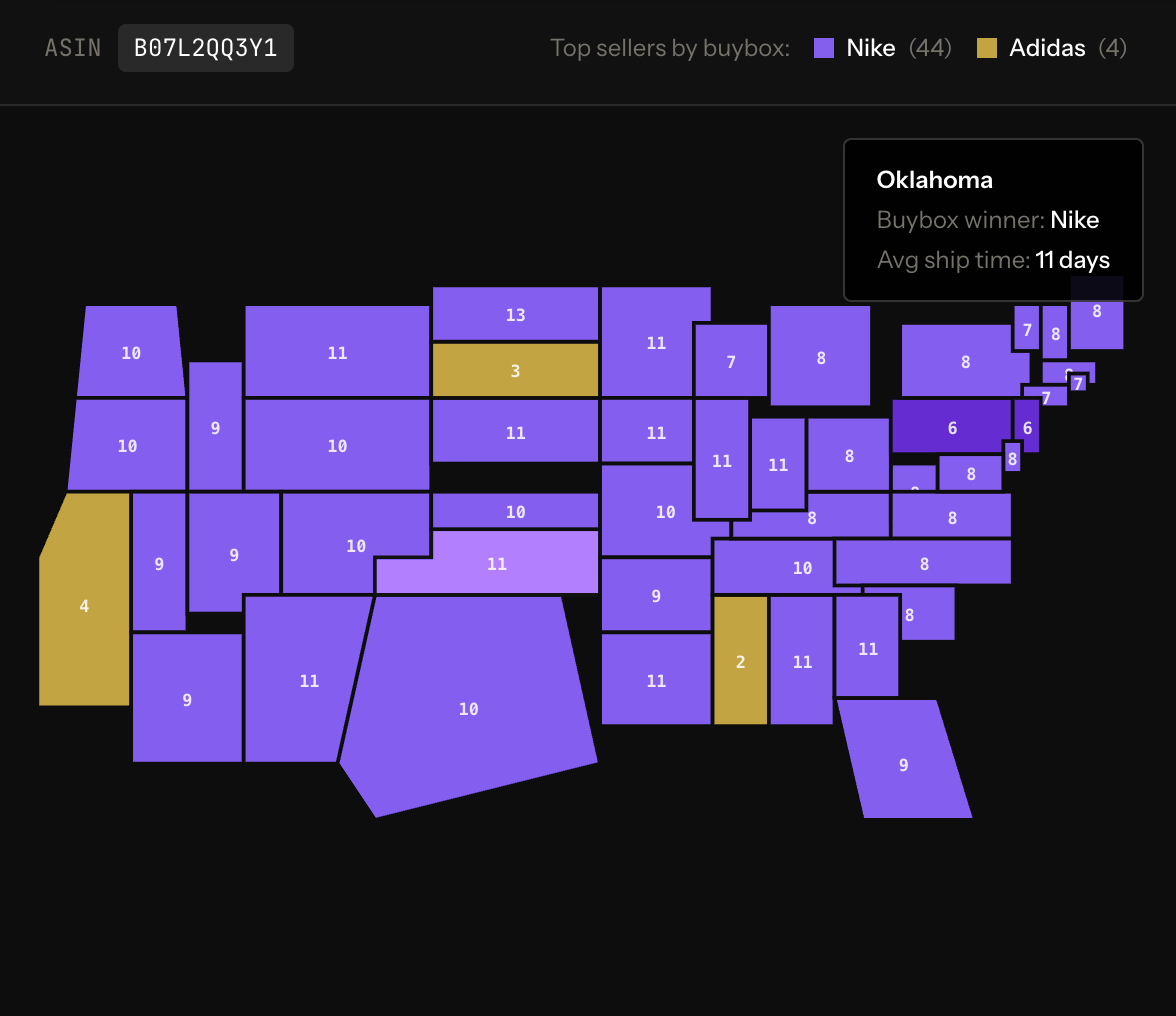
Most sellers look at Buy Box ownership as a single national metric. That is the wrong level of granularity. Amazon's Buy Box algorithm factors in delivery time by geography — which means a seller winning in California with FBA from an LA fulfillment center might be losing in Maine where delivery takes 5+ days.
With state-level Buy Box data from Asgard's offers endpoint, you can see which seller wins in each of the 50 states and what their average shipping time commitment is. This gives you three actionable signals:
- Where to place inventory — If you are losing the Buy Box in 15 states because a competitor promises faster delivery from a nearby warehouse, that is a direct case for adding an FBA node or 3PL in that region.
- Where FBM is viable — In states where your FBM shipping times already match or beat the current Buy Box winner, you may not need FBA at all. Protect your margin.
- Where to model fulfillment improvements — If moving average delivery from 5 days to 2 days in 10 states would likely flip Buy Box eligibility, you can model the ROI of that infrastructure change before making it.
Building a repricing strategy around Buy Box signals
Price is often the lever sellers reach for first, and it is a valid one — but only when used precisely. Blindly cutting price to win the Buy Box in every state wastes margin and triggers races to the bottom.
A data-driven repricing strategy looks like this:
- Pull current Buy Box winner price and shipping promise per state in real time.
- Compare against your landed price (price + shipping cost) in that region.
- Only reprice where the delta is within your floor-to-ceiling range and where price is the limiting factor, not fulfillment speed.
- Flag states where the Buy Box winner is winning on delivery time, not price — those require a fulfillment fix, not a price cut.
This is exactly what Asgard's offers and product prices endpoints enable. You get the competitor's current price, any active promotions or coupons they are running, and the shipping promise — all in a single API call, updated in real time.
Monitoring competitor deals and promotions
One of the most under-monitored signals is when a competitor runs a Lightning Deal, Prime Exclusive Discount, or coupon. These events temporarily drop their effective price — sometimes by 20–40% — which can knock you out of the Buy Box even if you were winning before the deal started.
With real-time promotion monitoring, you can:
- Detect a competitor Lightning Deal within minutes of it going live.
- Automatically adjust your own price within your floor rules to stay competitive during the deal window.
- Reset pricing when the deal ends, without over-correcting.
The infrastructure view
Winning the Buy Box at scale is not a manual process. It requires a data pipeline that pulls competitor prices, promotions, shipping promises, and stock levels continuously — and feeds that into a repricing engine with floor and ceiling guardrails.
Asgard provides the data layer. The offers endpoint returns seller-level data including price, shipping, fulfillment method, and active deals. The product page endpoint returns the current Buy Box winner and their terms. Combined, you have everything your repricer needs to make decisions that are grounded in real market conditions rather than stale snapshots.
The sellers that win the Buy Box consistently are not guessing. They are running a system. The data infrastructure exists — the question is whether you are using it.