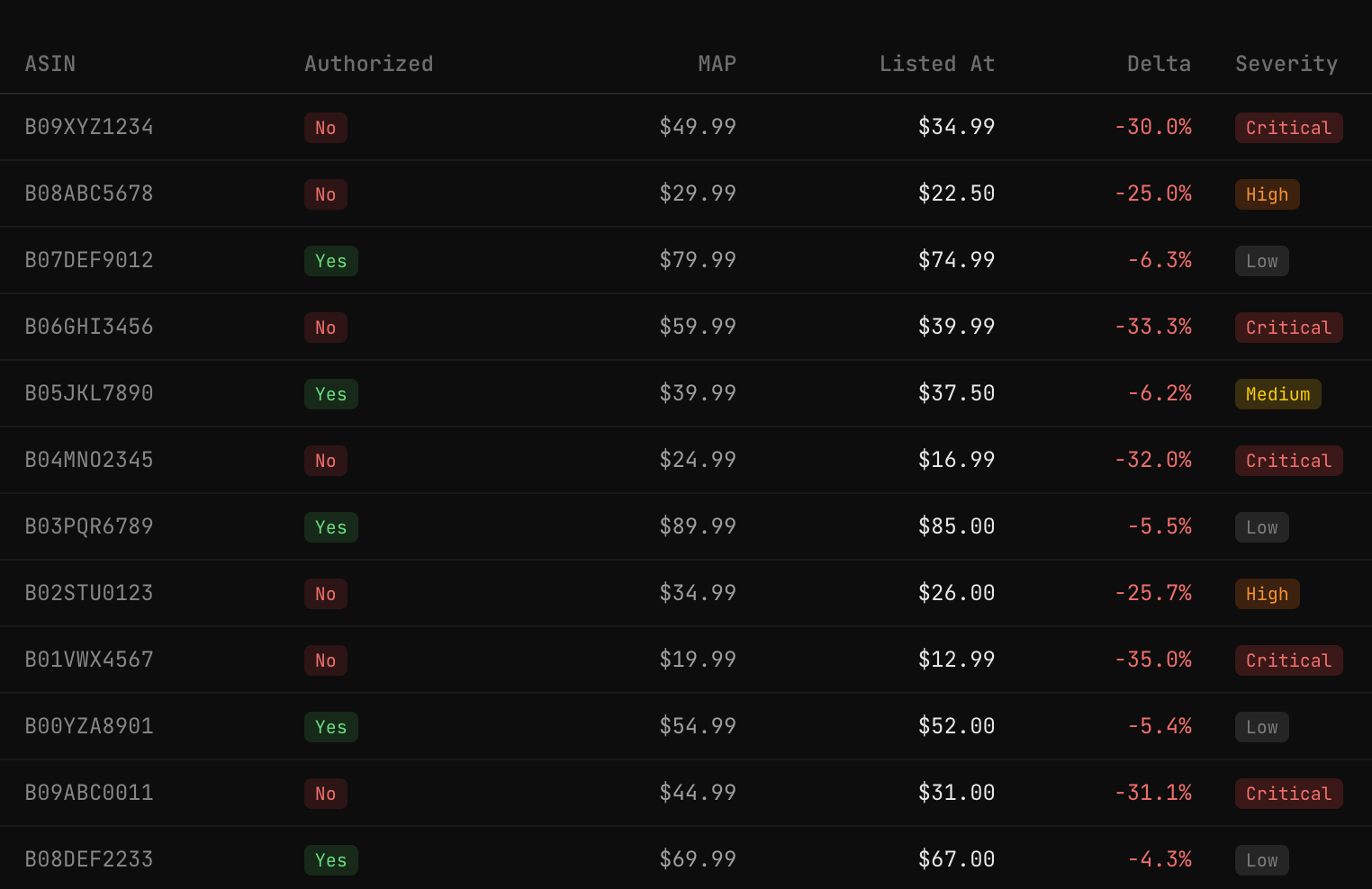
Minimum Advertised Price policies exist for a reason: they protect brand equity, preserve reseller margins, and prevent the race-to-the-bottom pricing dynamics that destroy premium positioning. But a MAP policy without enforcement is just a document. Enforcement requires data.
On Amazon, MAP violations are common, often hidden, and can spread quickly across a catalog once one seller breaks the price floor. The challenge is detection at scale — monitoring hundreds of ASINs across dozens of sellers in real time is not something a manual process can handle.
How MAP violations happen on Amazon
There are several common patterns:
- Unauthorized resellers — Third-party sellers who acquired your product through liquidation, grey-market channels, or unauthorized distributors, and who are not bound by your MAP agreement.
- Coupon and deal stacking — Authorized resellers who technically list at MAP but apply coupons that bring the effective price below it. Amazon displays the post-coupon price prominently, which has the same brand-damaging effect.
- Lightning Deals and Prime Exclusives — Sellers running time-limited deals below MAP, often reasoning that a temporary promotion is not a MAP violation — even when it functionally is.
- Algorithmic repricing races — When one seller drops below MAP, other sellers' repricers follow automatically, creating a cascade that can take the entire listing below floor pricing within hours.
What a monitoring system needs to detect
Effective MAP monitoring requires pulling several data points per ASIN per seller:
- Current listed price
- Any active coupons or promotions that reduce effective price
- Whether the seller is on your authorized reseller list
- Fulfillment method (FBA vs FBM affects Buy Box eligibility and visibility)
- Shipping cost (landed price, not just item price)
Asgard's offers endpoint returns all active seller offers for a given ASIN, including price, shipping, fulfillment method, and any active promotions. Combined with the promotions endpoint, you get both the listed price and the effective price after any active deals.
Building the enforcement workflow
Detection is step one. The response to a detected violation is what actually protects your brand. A practical enforcement workflow typically looks like:
- Detection — Flag any seller listing below MAP, weighted by severity (how far below MAP and how long it has been active).
- Authorization check — Cross-reference the seller against your authorized reseller list. Unauthorized sellers get escalated immediately. Authorized sellers get a notice.
- First notice — Automated cease-and-desist notice to the seller via Amazon's messaging system or your brand registry tools.
- Supply restriction — If the violation continues after notice, flag the seller for supply restriction. Stop selling to them through your distribution channels.
- Escalation — For persistent unauthorized sellers, use Amazon's Brand Registry report a violation tool or pursue legal options.
The data infrastructure required
Monitoring a catalog of 200 ASINs across 30+ active sellers means tens of thousands of price checks per day. This cannot be done with manual spot checks or weekly reports — by the time you see the data, the damage is already done.
Real-time MAP monitoring requires an API that pulls current seller offer data continuously, handles Amazon's anti-bot measures transparently, and returns clean, structured data that feeds directly into your enforcement workflow. The monitoring system should surface violations within minutes of them appearing, not hours or days.
Brand equity is not rebuilt quickly once it erodes. The sellers who protect their positioning most effectively are the ones treating MAP enforcement as an operational discipline backed by data infrastructure, not a quarterly audit.