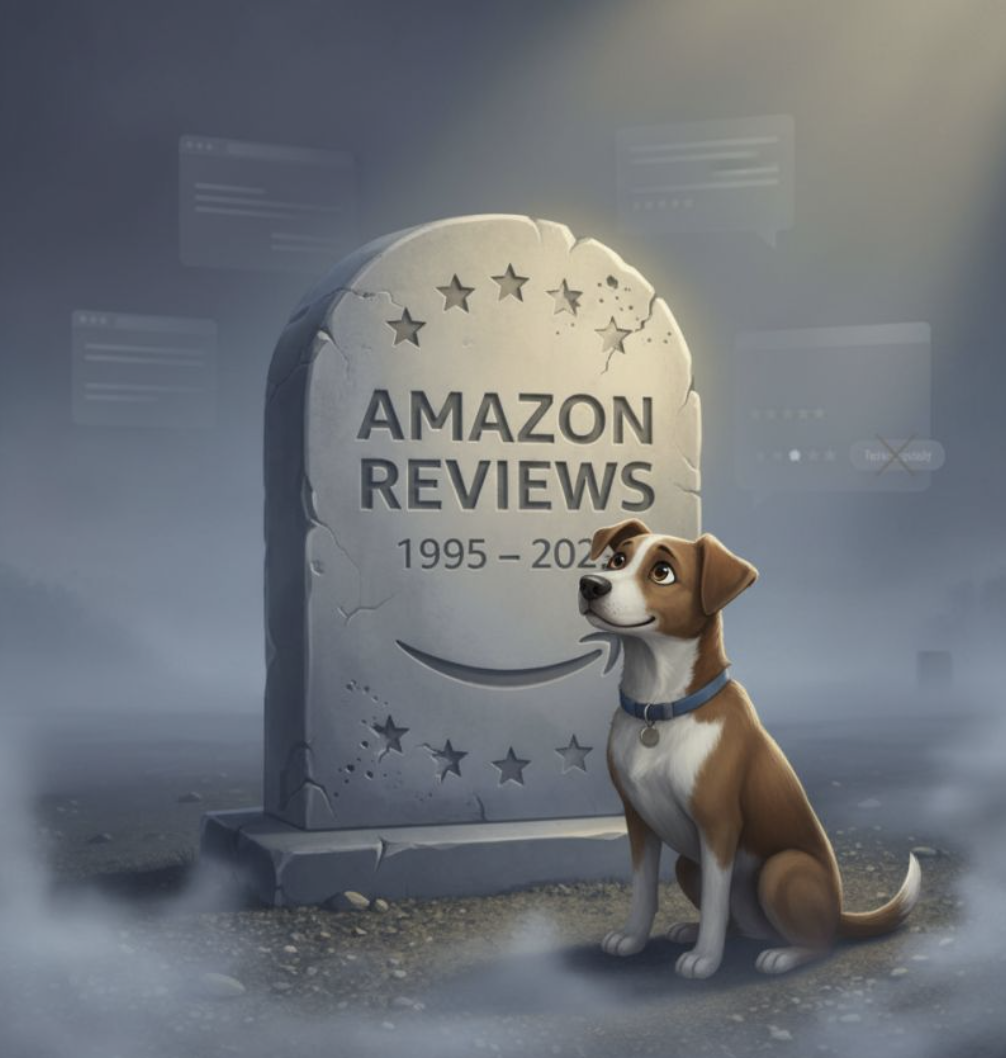
Amazon displays roughly 8 to 10 reviews on a product page without requiring any kind of account. Scroll down far enough and they stop. To see the rest, you have to click through paginated review pages, and on mobile or in certain markets, you hit an authentication wall almost immediately. This is not a coincidence or a technical oversight. It is a deliberate access boundary, and it puts bulk review scraping in the same legal category as scraping Rufus.
We have had clients ask us to pull full review histories for ASINs, sometimes thousands of reviews going back years. The ask is understandable. Reviews are genuinely valuable data: sentiment trends, recurring complaints, feature requests buried in one-star ratings, phrases customers actually use that you can fold into your copy and backend keywords. The data is useful. The access method is where it breaks down.
What is actually publicly accessible
The first page of reviews on any product listing is public. No account required, no session cookie, no authentication header. A standard HTTP request to a product page returns the top reviews Amazon has chosen to surface, typically sorted by recency or helpfulness depending on the URL parameters. That data is fair game under the same logic that makes price and BSR scraping legally defensible: it is publicly visible to anyone on the internet without a login.
What is not publicly accessible is everything beyond that first page. Paginated review endpoints, the full review corpus, star breakdowns by attribute, the review filter system. All of that either requires authentication or is served through API calls that Amazon treats as session-dependent. Hitting those endpoints without an account gets you blocked quickly. Hitting them with a created account puts you back in the same territory as the Perplexity case we wrote about in the Rufus post.
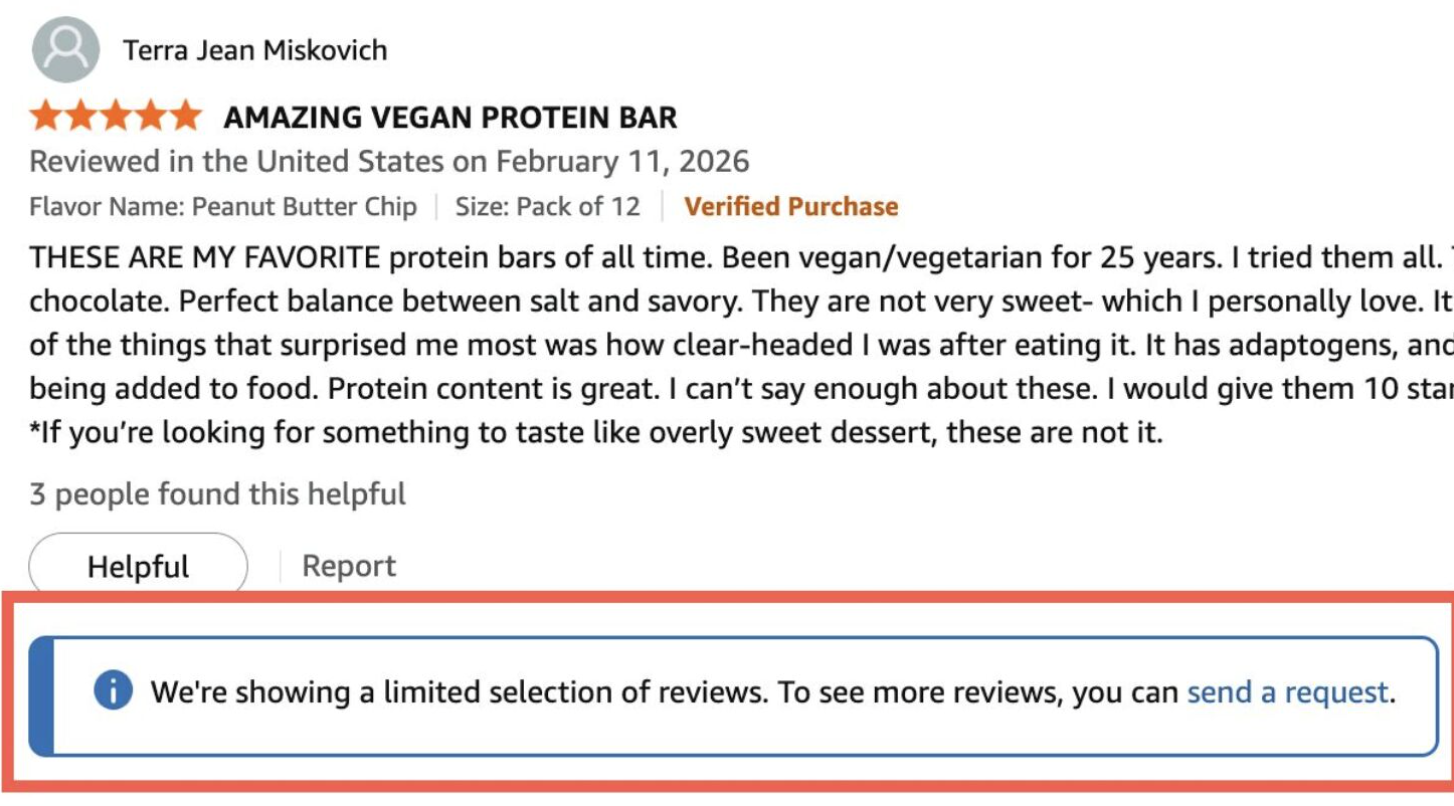
That message is Amazon's public-facing explanation. Behind the scenes, every subsequent review request beyond that surface sample requires session authentication. The "send a request" link is not a workaround. It routes through Amazon's logged-in flow.
A theory worth considering: this is not about sellers
Here is the part most people in the Amazon space are not talking about. The real reason Amazon locked down review access may have nothing to do with scraping tools built for sellers, and everything to do with external AI.
Amazon does not want GPT, Claude, Gemini, or any other external AI model to have access to its review corpus. Not to recommend products to their users directly. Not to train their models on years of customer language and purchasing sentiment. Not to power third-party shopping experiences that route purchase intent away from Amazon's own storefront.
Rufus already has all of that data internally. Amazon built Rufus to keep shoppers inside its ecosystem and to use review data to power its own AI recommendations. Allowing public access to the full review corpus would hand the same raw material to every AI competitor building a shopping agent. So the trade Amazon is making looks something like this: limit what is publicly visible, absorb the minor friction it creates for actual shoppers, and in exchange cut off the external AI ecosystem from one of the richest consumer intent datasets on the internet.
This is our read on what is happening. The timing of review access restrictions correlating with the rise of AI shopping agents is not something we would dismiss as coincidence, and the Perplexity ruling fits the same pattern.
Why this matters for anyone buying third-party review data
Most tools and services claiming to provide full review datasets are either working from cached historical snapshots, operating through methods that violate Amazon's terms of service, or both. That does not automatically make the data worthless. It means you should understand where it came from and what exposure comes with it if Amazon decides to trace the activity back through the supply chain.
Amazon has shown it will pursue legal action when it wants to. Review scraping at scale is something they have been aware of for years. The fact that enforcement has been inconsistent does not mean the legal exposure has gone away. It means they have not decided to act on it yet, or that their current focus is cutting off the AI layer rather than individual sellers.
What you can actually build with what is public
The first page of reviews, collected consistently over time, is more useful than most people give it credit for. If you are pulling the top 8 to 10 reviews for a set of ASINs every day, you can:
- Track review velocity. How fast is a competitor accumulating reviews in a category? A sudden spike in the surface sample is a signal worth knowing about.
- Monitor rating drift. A product at 4.7 stars six months ago that is now at 4.3 stars is telling you something, even through a small sample.
- Capture the language customers use first. Amazon surfaces its most helpful and most recent reviews at the top. That sample reflects what shoppers are most likely to read before buying, which is exactly the language you should be using in your copy.
- Track your own review profile. The reviews Amazon chooses to show on page one for your ASIN are the ones doing the most work for or against your conversion rate.
None of that requires authentication. All of it is available through our reviews endpoint, which pulls exactly what is publicly visible on the product page.
The pattern is consistent
Rufus, paginated reviews, the full Q&A corpus beyond what surfaces publicly. All of it sits behind authentication for the same underlying reason: Amazon is building a data moat. The surface layer stays public because Amazon needs it to function as a marketplace. The depth gets locked down because that depth is what powers AI, and Amazon is not interested in fuelling anyone else's models with it.
We are not in the business of helping clients take on that risk. What we do is build reliable infrastructure for the data that is genuinely public, and be direct with you about where the line is. If you want to talk through what is actually available for your use case, get in touch.
We want to grow your brands, not get you in trouble with Amazon legally. There are other scrapers out there who will tell you they can do it. Until they disappear.