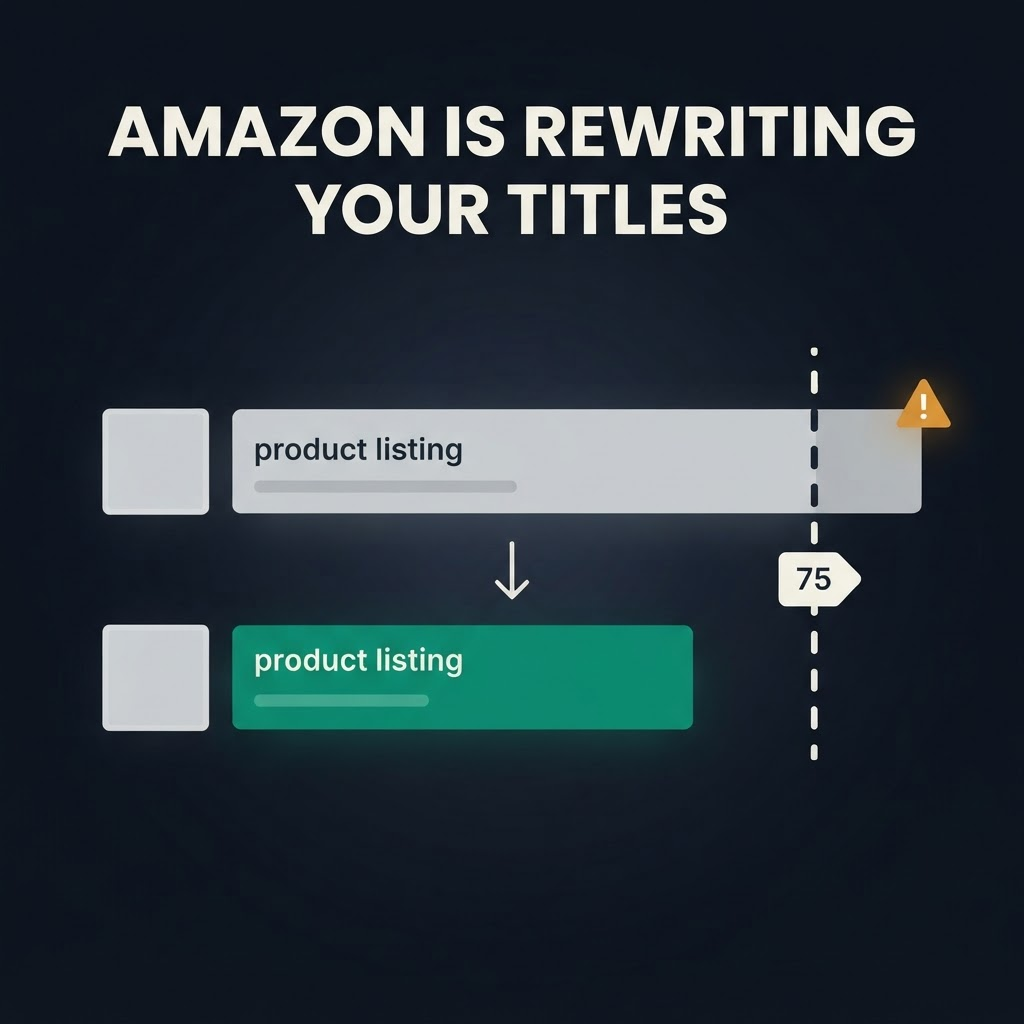
Amazon starts rewriting product titles today. I want every Amazon seller to sit with this for a second, because most catalogs I've looked at haven't touched a single title.
From today, titles in every category except media must be 75 characters or less, including spaces. Anything longer gets rewritten to Amazon's AI recommendation. Brand owners get 14 days to review. Then it ships.
What Amazon actually announced
The official notice went up on June 10 — six weeks of notice — and the rules are simple:
- 75-character title cap across all categories except media, starting July 27, 2026.
- Item Highlights gives you an extra 125 characters for materials and use cases. It's searchable and shows next to your title in search results and on the detail page.
- AI rewrites are gradual. Any title still over 75 characters after today gets replaced by Amazon's AI recommendation over time. Listings stay active throughout.
- Brand owners get 14 days to review, modify, and approve the AI title and Item Highlights in Review Listing Changes before it goes live.
This is what nobody is pricing in
When Amazon rewrites a title, the exact keyword you rank on can move or vanish. Your title is one of the strongest relevance signals Amazon has — change the words and the indexing changes with it.
The chain reaction is predictable:
- Keyword rank moves or drops.
- CTR slips because the title no longer matches intent.
- Conversion follows CTR.
- BSR follows conversion.
And here's the quiet killer: your exact-match campaigns don't know this happened. You'll keep bidding on terms your listing may no longer be indexed for, and you'll see the damage in your August numbers — about three weeks after you stopped controlling your own shelf.
How to actually watch this happen
The problem with a gradual, silent rollout is that you won't get an alert when your title changes — you'll just notice sales dipped weeks later. The only way to stay ahead of it is to monitor two things continuously:
- Title & Item Highlights monitoring — scrape your ASINs on a schedule and diff the title and highlight fields day over day. The moment Amazon's AI rewrites a title, you see the exact before/after instead of finding out from a BSR drop.
- Keyword rank tracking — track organic rank for your money keywords in parallel, so when a title changes you can immediately see which keywords moved and by how much.
Put those two together and the invisible becomes obvious: a title changes, you catch it within a day, and you see exactly which ranks it cost you — while there's still time to fix the title or adjust your exact-match campaigns before August.
We built Asgard scrapers for exactly this: real-time keyword rank tracking plus ASIN title and highlight field monitoring across marketplaces. If you want to watch your top 20% of ASINs through this rollout, that's the setup.