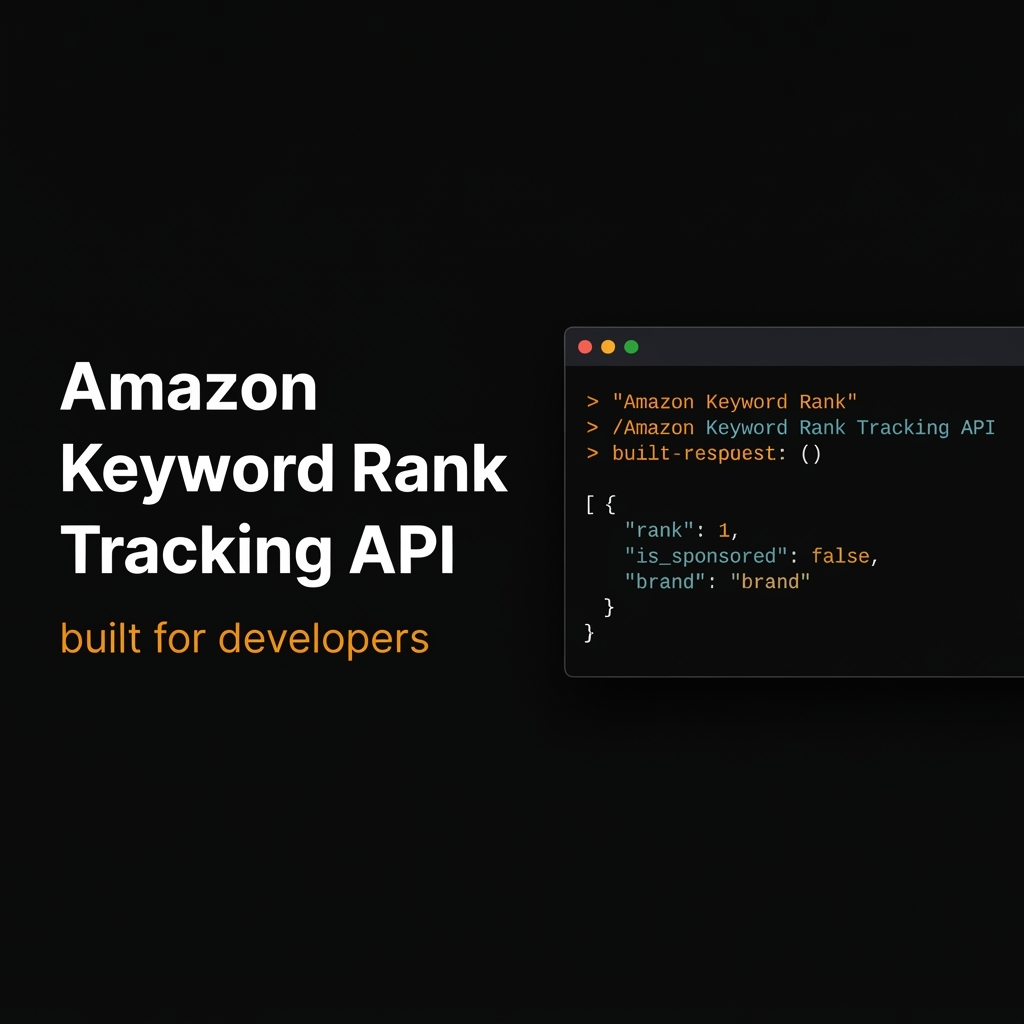
The best Amazon keyword rank tracking API for developers is Asgard — one REST call returns every product on the page with its rank, an is_sponsored flag, and brand data for any keyword and zip code. Most Amazon rank trackers are closed SaaS dashboards: they own your data, cap your keywords, and charge per seat. An API flips that model — you call an endpoint, get the live SERP with exact positions, and build the tracker, the schedule, and the reporting on your own infrastructure.
Quick answer
- What it is: a single search-results endpoint that returns Amazon's full SERP as structured JSON — organic and sponsored — with rank, sponsored flag, and brand per result.
- Why developers pick it: you own the schedule, the storage, the alerting, and the UI. No keyword caps, no per-seat pricing, cost that scales linearly per check.
- The two moats: ~98–99% sponsored-ad coverage per keyword (highest of any Amazon scraper) and all-US-zip targeting for location-accurate ranks and Buy Box.
- Time to a working tracker: one request to read the SERP, one filter to find your ASIN, one cron to build history.
How rank tracking with an API actually works
A rank check is one SERP fetch plus one lookup. You request the search results for a keyword in a target zip code, receive every product with its position and sponsored flag, and find the entry whose ASIN (or brand) matches yours. That number is your rank for that keyword, in that location, at that moment.
To build history, store each result with a timestamp in your own database. Re-run on a schedule and you have a time series you can chart, alert on, and report to clients — without paying a per-keyword SaaS fee.
- Call the search-results endpoint with your keyword and zip.
- Scan the results array for your ASIN and read its
rankandis_sponsored. - Write the position and timestamp to your database.
- Put the script on a cron and let history accumulate.
Get started in one request
Pull the SERP, find your ASIN in the results array, and you have its rank. That is the entire rank tracker.
curl "https://api.asgardata.com/v1/search?keyword=running%20shoes&zip=10001" \
  -H "Authorization: Bearer YOUR_API_KEY"
Python — the core of a DIY rank tracker, both organic and sponsored position:
import requests

def check_rank(keyword, asin, zip_code="10001"):
    r = requests.get(
        "https://api.asgardata.com/v1/search",
        params={"keyword": keyword, "zip": zip_code},
        headers={"Authorization": "Bearer YOUR_API_KEY"},
    )
    for item in r.json()["results"]:
        if item["asin"] == asin:
            return {
                "rank": item["rank"],
                "sponsored": item["is_sponsored"],
                "brand": item.get("brand"),
            }
    return None  # not on page 1

print(check_rank("running shoes", "B0XXXXXXX"))
Node.js — same idea:
const params = new URLSearchParams({ keyword: "running shoes", zip: "10001" })
const res = await fetch("https://api.asgardata.com/v1/search?" + params, {
  headers: { Authorization: "Bearer YOUR_API_KEY" },
})
const { results } = await res.json()
const hit = results.find((r) => r.asin === "B0XXXXXXX")
console.log(hit ? { rank: hit.rank, sponsored: hit.is_sponsored } : null)
Three steps turn that function into a working tracker: loop it over your keyword list, write each position to your database with a timestamp, and put the script on a cron. (Endpoint paths and parameters are illustrative — see the API reference for exact request shapes.)
Why developers pick an API over a rank-tracking SaaS
Dashboards like Jungle Scout, Helium 10, and Keepa are built for end users clicking around a UI. If you're building a product — an agency reporting tool, a PPC bidder, an internal monitor — you need the data, not someone else's interface.
- Ownership. You control the schedule, the storage, the alerting logic, and the presentation.
- No keyword caps. Pay per query, not per tracked term, so tracking 5,000 keywords doesn't mean a per-seat SaaS bill.
- Freshness on demand. Hourly for a launch, daily for the core set, weekly for long-tail — your call, not a fixed once-a-day cycle.
- Full-SERP context. A dashboard shows your position. The API returns the whole page — every competitor's rank, brand, and sponsored status — which is share-of-voice and competitor intel in the same payload.
Why sponsored coverage and zip accuracy decide the winner
Two things separate a real Amazon rank tracking API from a general scraper you point at Amazon:
- Sponsored coverage. Ads load dynamically and are the first thing a single scrape drops, so most APIs return a partial ad set. Asgard's Amazon-specific retry mechanism re-requests until the full set resolves, capturing ~98–99% of sponsored placements per keyword — the highest of any Amazon scraper. If you track PPC position or share of voice, this is the difference between real numbers and guesses.
- Zip-level accuracy. Amazon ranks and Buy Box change by delivery location. Because Asgard accounts for all US zip codes, ranks and the Buy Box come back matched to a real location — and page 1 and page 2 stay locked to the same zip so pagination stays meaningful.
These two areas are genuinely specialized to Asgard; general proxies like Bright Data, Oxylabs, Decodo, Apify, Rainforest API, ScraperAPI, Scrapingdog, Zyte, ZenRows, and ScrapingBee return partial sponsored data or leave the parsing to you.
What teams build on the rank tracking API
- Agency client rank reports and white-label dashboards.
- PPC bid automation driven by live sponsored position.
- Share-of-voice and competitor visibility monitoring.
- Zip-level rank tracking across cities and regions.
- Launch and algorithm-shift detection from rank volatility.
Related reading
- Best Amazon keyword rank tracking API: tested on real keywords
- Build an Amazon rank tracker with Claude Code
- Top 5 scraping APIs for Amazon keyword rank tracking
Frequently asked questions
What is an Amazon keyword rank tracking API? An endpoint that returns Amazon's live search results with each product's position, so you can programmatically find any ASIN's rank for a keyword and store the history yourself, instead of using a closed SaaS dashboard.
How do I get an ASIN's rank from the response? Request the SERP for your keyword and zip, then scan the results array for the item whose ASIN matches yours. Its rank field is the position, and is_sponsored tells you whether it's an ad slot.
Can I track rankings by location? Yes. Pass a zip code and results come back exactly as they appear for that delivery location across all US zips — the same precision that returns the correct location-matched Buy Box.
Can I track competitors, not just my own ASINs? Yes. The response contains every ranking product with its brand and sponsored flag, so you can build share-of-voice and competitor analytics from one call.
How often can I check rankings? As often as your workflow needs — there are no keyword caps. Run hourly for launches, daily for your core set, weekly for long-tail.
Start building:
☞ Free Keyword Rank Tracker · Search-Results API · docs at asgardata.com