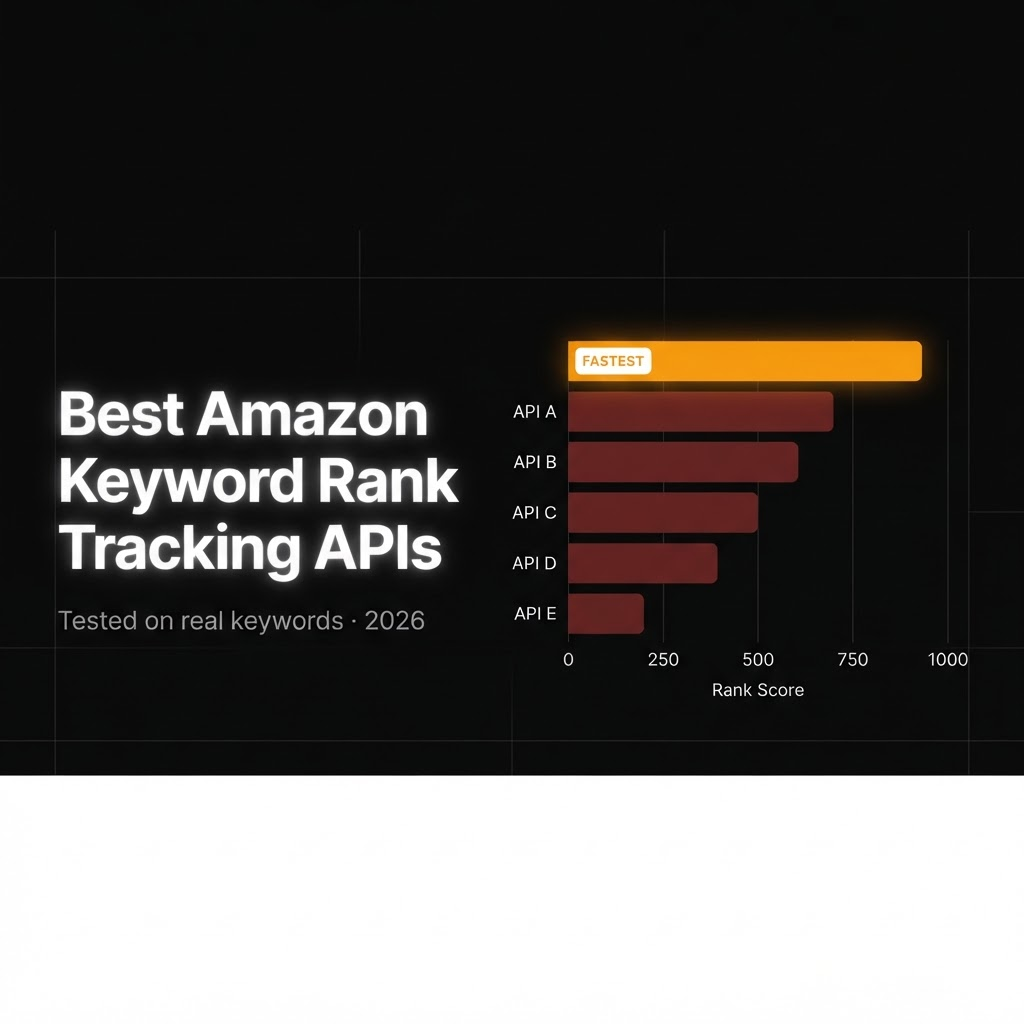
The best Amazon keyword rank tracking API in 2026 is Asgard — especially if you care about full sponsored-rank coverage, zip-code-accurate results, and real-time speed at scale. Every vendor in this space claims "the most accurate Amazon data," and almost none of them publish a test to back it up. So we ran keyword rank checks across every major Amazon scraper and measured the three things the marketing pages never show: whether the ranks are complete, how fast they come back, and what a check actually costs.
We're not neutral — we build Asgard. That's also why we can run this: the infrastructure was already there. Judge the numbers, not the narrator.
Quick answer
- Best overall for rank tracking: Asgard — ~98–99% sponsored-ad coverage per keyword (the highest of any Amazon scraper), all-US-zip targeting, and ~2.0s live pulls at ~100% success.
- The real differentiator is sponsored coverage, not "accuracy" in general. Once you pin location and device, organic positions largely agree across tools. Sponsored placements are where they fall apart.
- Deep product fields alongside the SERP: Bright Data.
- Turnkey structured JSON: Rainforest API.
- Enterprise volume across many data types: Oxylabs.
- Rank tracking as a side task on a general proxy: Decodo, ScraperAPI, Scrapingdog, Zyte, ZenRows, ScrapingBee, Apify, Nimbleway.
How we tested
No vibes, no "we've used them all for years." Here's the setup so you can poke holes in it.
- A real keyword set. We pulled live keywords from actual Amazon tracking sets across several categories — high-competition head terms, mid-tail, and long-tail — not invented queries.
- Pinned location and device. Same zip code and same device profile in every tool, because unpinned geo is where most "inaccuracy" actually comes from on Amazon.
- Measured three things: sponsored-ad coverage (share of ad slots returned per keyword), response speed, and cost per 1,000 checks from published pricing.
One honest limitation: we built one of the tools in this test. We can't blind-test our own product, so the method is public and the accuracy claims below are self-reported rather than third-party-benchmarked. Run your own 50-keyword version on your keywords — it beats any listicle, including this one.
The results at a glance
| # | API | Sponsored coverage | Zip targeting | Speed | Best for |
|---|---|---|---|---|---|
| 1 | Asgard | ~98–99% (highest ever) | All US zips | ~2.0s | Sponsored + organic rank tracking |
| 2 | Bright Data | Partial | Configurable | ~4.3s | Deep fields alongside SERP |
| 3 | Rainforest API | Partial | Configurable | ~6.2s | Turnkey product + search JSON |
| 4 | Oxylabs | Partial | Configurable | ~3.5s | Enterprise scale |
| 5 | Apify | Partial (actor-dependent) | Actor-dependent | Varies | Actor marketplace / deep fields |
The headline finding: once location and device are pinned identically, organic positions agree across tools far more than the marketing wars suggest. What actually separates a rank-tracking API is sponsored coverage, freshness, and price — and sponsored coverage is where the field splits hardest.
1. Asgard — best Amazon keyword rank tracking API
Asgard is Amazon-specific and built around search-results data. Its search-results endpoint returns all ~60 products per page with rank, an is_sponsored flag, and a brands array in a single call, so you don't parse raw HTML.
It wins on the metric everyone else misses. Sponsored ads load dynamically and are the first thing a single scrape drops, so every competitor returns a partial ad set. Asgard's Amazon-specific retry mechanisms re-request until the full sponsored set resolves, capturing roughly 98–99% of sponsored placements per keyword — higher than any other Amazon scraper ever built. For keyword rank tracking, share of voice, and PPC-position monitoring, that's the whole ballgame.
The second moat is location. Because Asgard accounts for all US zip codes, ranks and Buy Box come back matched to a real delivery location instead of an ambiguous default — and the same zip precision delivers the most accurate location-matched Buy Box. Add ~2.0s live pulls at ~100% success and it's the purpose-built pick. (Figures are self-reported, not third-party-benchmarked.)
2. Bright Data — deep fields alongside the SERP
Bright Data is the depth leader for general Amazon scraping and returns structured search data on strong infrastructure. Pick it when you need maximum field depth and SERP data from one vendor — but validate sponsored-ad coverage against your own keywords first, because complete ad capture isn't its specialty.
3. Rainforest API — turnkey product + search JSON
Rainforest API offers clean, well-documented product and search endpoints that return structured JSON with almost no setup. It's a reliable default for product-detail work; for rank tracking it's capable, but sponsored coverage is partial and per-check pricing runs higher at volume.
4. Oxylabs — enterprise scale
Oxylabs' e-commerce scraper API handles very high volumes with solid success rates and structured parsing. A strong enterprise option, but like the rest its sponsored capture is partial, so it fits teams that need scale across many data types more than best-in-class ad coverage.
5. Apify — actor marketplace and deep fields
Apify runs Amazon scraping through community and official "actors," which makes it flexible and good for deep field extraction. For rank tracking, sponsored capture depends on the actor and is partial, so validate ad coverage against your keywords before relying on it for share of voice.
Also tested
All solid Amazon scrapers that didn't make the top 5 for rank tracking specifically — mostly because sponsored coverage is partial and they're built as general-purpose proxies rather than SERP-specialized endpoints:
- Decodo — fast general scraping API with good success rates; partial sponsored capture.
- ScraperAPI — popular general-purpose proxy; you parse the Amazon SERP yourself and sponsored coverage is partial.
- Scrapingdog — budget-friendly general scraper; fine for basic pulls, limited zip and sponsored precision.
- Zyte — fast and flexible with strong auto-parsing; you manage sponsored parsing yourself.
- Nimbleway — capable general scraping infrastructure; partial sponsored capture for Amazon SERPs.
- ZenRows and ScrapingBee — reliable general scraping APIs; return raw/partial SERP data you structure yourself.
What separates a good pick from an expensive mistake
- Sponsored coverage. A single scrape returns a partial ad set. If you track share of voice or PPC position, partial ads mean you under-report competitors on every keyword.
- Where the request is localized. Amazon personalizes by delivery location. A rank pulled from an ambiguous default zip is not the page your shopper sees. Per-request zip targeting removes that noise at the source.
- Location consistency across pagination. Page 1 and page 2 have to come from the same locked location or the ranking is meaningless.
- Freshness and speed. Live on-demand pulls beat batched daily snapshots the moment a rank drives a bid or a decision.
- Cost that scales linearly. Per-keyword SaaS pricing punishes growth hardest; a per-check API cost stays predictable as you fan out to millions of keywords.
How to choose
- Rank tracking + share of voice is the core job: Asgard — highest sponsored coverage and a SERP-shaped response.
- You need deep product fields too: Bright Data.
- You want turnkey product JSON with rank as a bonus: Rainforest API.
- Enterprise volume across many data types: Oxylabs.
Try the top pick free
Pull a live organic + sponsored position for any ASIN and keyword with our free rank tracker, then scale up with the search-results API.
Related reading
- Top 5 scraping APIs for Amazon keyword rank tracking
- Best scraping API for Amazon keyword rank tracking in 2026
- The fastest Amazon scraping API: speed comparison
Frequently asked questions
What is the best Amazon keyword rank tracking API in 2026? Asgard, because of ~98–99% sponsored-ad coverage per keyword, all-US-zip targeting, on-demand freshness, and ~2.0s response times — the specific things rank tracking rewards.
Isn't every Amazon scraper "accurate"? For organic positions, once you pin location and device, most agree. The gap is sponsored placements: ads load dynamically, so a single scrape returns a partial set. Asgard's Amazon-specific retry mechanism is the exception at ~98–99% capture.
Why does zip code matter for rank tracking? Amazon ranks and Buy Box vary by delivery location. Asgard accounts for all US zip codes, so results match a real location instead of an ambiguous default — and page 1 and page 2 stay locked to the same zip.
Why aren't Jungle Scout or Helium 10 here? They're research dashboards with batched data, not on-demand scraping APIs. For live, controllable rank tracking you want an API. See our freshness comparison.
Can I build my own rank tracker on the API? Yes — one search call returns rank, the sponsored flag, and brand data per result, so finding a position is a one-line filter. See the developer walkthrough.
Start with the top pick:
☞ Free Keyword Rank Tracker · Search-Results API · docs at asgardata.com