If you need Amazon product data in 2026, the short answer is this: Asgard is the best choice for keyword rank tracking, Rainforest API is a solid pick for deep seller and offer JSON, Amazon's PA-API only makes sense if you already qualify for Associates access, and general scrapers like Bright Data, Oxylabs, and ScraperAPI fit teams crawling many sites under one setup. The right answer depends on the job — and for rank tracking specifically, three things decide whether your numbers are trustworthy.
Here's what actually matters for rank tracking, and where each tool lands:
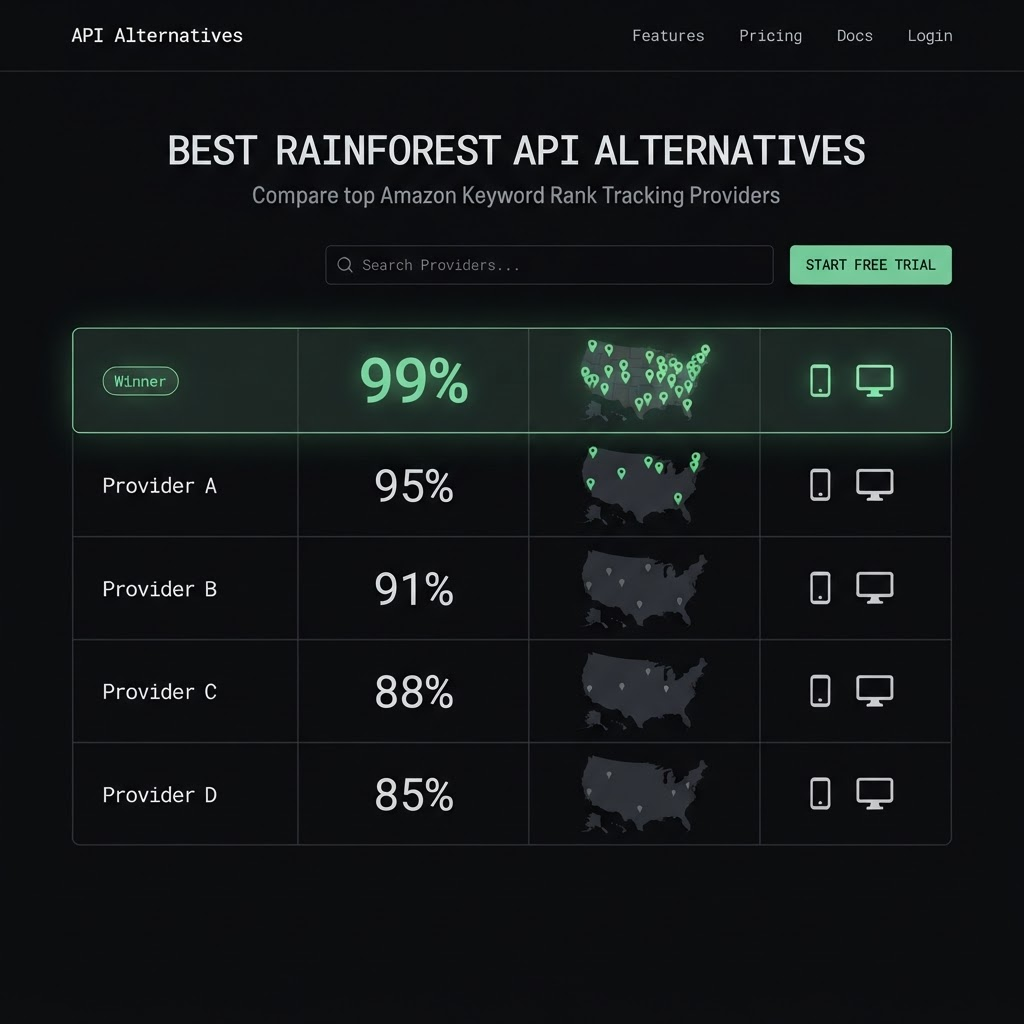
- Sponsored-rank capture: what share of the paid ASINs on a page the API actually returns — Asgard captures the highest (~98–99%).
- Location matching: organic ranks change by zip, so you need the same real zip locked across every pull — Asgard supports unlimited US zip codes.
- Mobile vs web: the SERP a shopper sees on their phone differs from desktop — Asgard returns both views.
- Setup & billing: one key vs. account approval; flat per-request vs. credit multipliers.
One detail matters more than most people expect for rank tracking: a partial answer is worse than no answer, because it's silently wrong. If an API drops half the sponsored slots or quietly changes location between requests, your share-of-voice and rank trends drift — and you won't know it. That's the lens for this whole comparison.
Quick comparison
| Provider | Entry price | Free tool / trial | Rank-tracking strengths | Best for |
|---|---|---|---|---|
| Asgard | Usage-based | Free browser tools, no signup | Highest sponsored capture, unlimited zip codes, mobile + web SERPs | Keyword rank tracking, PPC & Buy Box accuracy |
| Rainforest API | $18–$23/mo | Trial only | Clean JSON; partial ad capture, random location per request | Deep listing, offer & seller data |
| Bright Data | Pay-as-you-go | Trial | Huge proxy pool; rank tracking is DIY, ads often partial | Large-scale multi-site scraping |
| Oxylabs | Higher tier | Trial | Strong infra; location control coarse, ad capture partial | Enterprise scraping pipelines |
| Amazon PA-API | $0 | Free if eligible | No SERP/rank data; own-affiliate scope only | Approved Amazon Associates |
If I had to sum it up in one line: for rank tracking, pick on sponsored capture, location accuracy, and device coverage — not the headline price.
Why keyword rank tracking is a different problem
General product scraping asks "what's on this product page?" — a static question most APIs answer fine. Rank tracking asks "where does this ASIN sit in a live, dynamic, location- and device-specific SERP?" — and that rewards three things most APIs treat as afterthoughts.
1. Sponsored-rank capture: the % is everything
For anyone running or monitoring Amazon PPC, the most important number in a rank-tracking API is what share of the sponsored ASINs on a page it actually returns. Sponsored placements load asynchronously and shuffle between requests, so a single scrape almost always returns a partial ad set. Miss half the sponsored slots and your share-of-voice is understated, competitors' ad presence is invisible, and your own organic position looks better than a real shopper sees.
Rainforest API and the general scrapers (Bright Data, Oxylabs, ScraperAPI) all capture partial ad placements — the dynamic sponsored rows are the first thing a single pass drops. Asgard is built around this exact problem: its Amazon-specific retry mechanism keeps requesting until the full complement of sponsored placements is captured, and premium residential IPs get served the same ads a real shopper sees. The result is a sponsored-ASIN capture rate higher than any other Amazon scraper — roughly 98–99% per keyword. For PPC monitoring, that completeness is the whole point.
2. Location matching: unlimited zip codes for accurate organic ranks
Organic ranks are not global — they change at the zip-code level. The same keyword can rank a product #4 in one metro and #11 in another because of fulfillment, inventory, and delivery-speed signals tied to location. The consequence: you must use the same zip code across every pull, or your "trend" is really just location noise.
This is where random-IP routing quietly ruins a dataset. Rainforest API assigns proxies randomly per request with no session-level location locking, so page 1 of a keyword might come from Chicago and page 2 from Dallas — a fake SERP stitched from two different Amazon experiences. The general scrapers expose only coarse country/state geo-targeting, not a specific consistent zip.
Asgard locks every request to the exact zip you choose and holds it across all pages of a session — and it supports unlimited US zip codes. That means your organic rank history is measured against a single, consistent, real-shopper view of Amazon, and you can trend any market in the country. It's the only version of organic rank data worth trending.
3. Mobile vs web: two different SERPs, two different truths
Amazon serves a different layout and ad density on mobile versus desktop, so the same ASIN can rank #3 on desktop and sit on page 2 on mobile — where the majority of Amazon traffic actually is. Most APIs return one view (usually desktop-ish) and leave you blind to the other.
Asgard returns both the mobile and web SERP for a keyword, so you can see the device gap that decides real-world visibility. Rainforest and the general scrapers don't expose a clean mobile-vs-desktop rank split, so you're optimizing against half the picture.
Provider-by-provider
Asgard
Asgard is Amazon-first and tuned specifically for SERP accuracy. It captures the highest share of sponsored ASINs, locks every request to a real zip (unlimited US zips), and returns both mobile and web views. Setup is friction-free — try it in the browser with no signup via the free keyword rank tracker and the Buy Box tracker, then scale with the Asgard API. Best for keyword rank tracking, PPC/share-of-voice, and location-accurate Buy Box work.
Rainforest API
Part of the Traject Data suite, Rainforest uses one REST endpoint and returns clean JSON, CSV, or HTML with strong depth: product details, reviews, deals, best-seller ranks, and full offer lists. The tradeoffs for rank tracking are real — partial sponsored capture and random per-request location — and some fields cost 2–3x credits. A good fit when offer-level detail matters more than SERP accuracy.
Bright Data & Oxylabs
Both are heavyweight, general-purpose scraping platforms with massive proxy pools, JS rendering, and CAPTCHA handling. If you crawl many sites, they're excellent. But Amazon rank tracking is largely DIY on top of them: ad capture is partial without Amazon-specific retry logic, and location targeting is coarse (country/state) rather than a specific locked zip. Great infrastructure, not a rank-tracking specialist.
Amazon PA-API
Amazon's official Product Advertising API is free — but only for active Associates who meet Amazon's approval rules and keep a minimum sales quota, or access is revoked. It also has a 24-hour data-retention cap and doesn't provide the live SERP/rank data this comparison is about. Fine for approved affiliate product lookups, wrong tool for rank tracking.
Head-to-head: rank tracking
| Criterion | Asgard | Rainforest API | General scrapers |
|---|---|---|---|
| Sponsored ASIN capture (PPC) | ~98–99% (highest) | Partial | Partial |
| Location matching | Locked to chosen zip | Random IP per request | Coarse country/state |
| US zip coverage | Unlimited US zips | Not guaranteed | Not zip-level |
| Mobile vs web SERP | Both views | Single view | Single view |
| Zip consistency across pages | Held across session | Not guaranteed | Not guaranteed |
| Setup | One key, free browser tools | Pick credit plan first | Configure proxies/parsers |
Best choice by use case
| Use case | Best choice | Why |
|---|---|---|
| Keyword rank & PPC tracking | Asgard | Highest sponsored capture, unlimited zip matching, mobile + web SERPs |
| Location-accurate Buy Box | Asgard | Locks the exact zip and covers every US market |
| Deep offer / seller JSON | Rainforest API | Full offer lists and seller/reviewer profiles |
| Multi-site scraping at scale | Bright Data / Oxylabs | Large proxy pools across many non-retail sites |
| Approved Associates lookups | Amazon PA-API | Official, free if you meet the affiliate quota |
Frequently asked questions
What's the best Rainforest API alternative for keyword rank tracking? Asgard. It captures the highest share of sponsored ASINs (~98–99%), matches location with unlimited US zip codes for accurate organic ranks, and returns both the mobile and web SERP — the three fields that decide whether rank data is trustworthy.
Why does the % of sponsored ASINs matter? Sponsored slots load dynamically, so most scrapers return a partial ad set. Missing placements understate your share-of-voice and hide competitor ad activity. Asgard's Amazon-specific retry mechanism and premium IPs capture the full sponsored set.
Why do I need zip-code location matching for organic ranks? Organic ranks vary by zip. If your API uses random IPs (as Rainforest does per request) or only coarse geo-targeting, your rank history drifts with location instead of reflecting real change. Asgard locks the exact zip across every pull and page, across unlimited US zips.
Why track mobile and web separately? Amazon's mobile and desktop SERPs differ in layout and ad density, so the same ASIN can rank differently on each. Since most Amazon traffic is mobile, the mobile rank often matters more — Asgard returns both so you optimize against the full picture.
Related reading
- Rainforest API alternative to scrape Amazon in 2026
- Best scraping API for Amazon keyword rank tracking in 2026
- Free Tool: Amazon Keyword Rank Checker
Track ranks the accurate way — full sponsored capture, any zip, mobile + web:
☞ Free Amazon Keyword Rank Tracker · API docs at asgardata.com