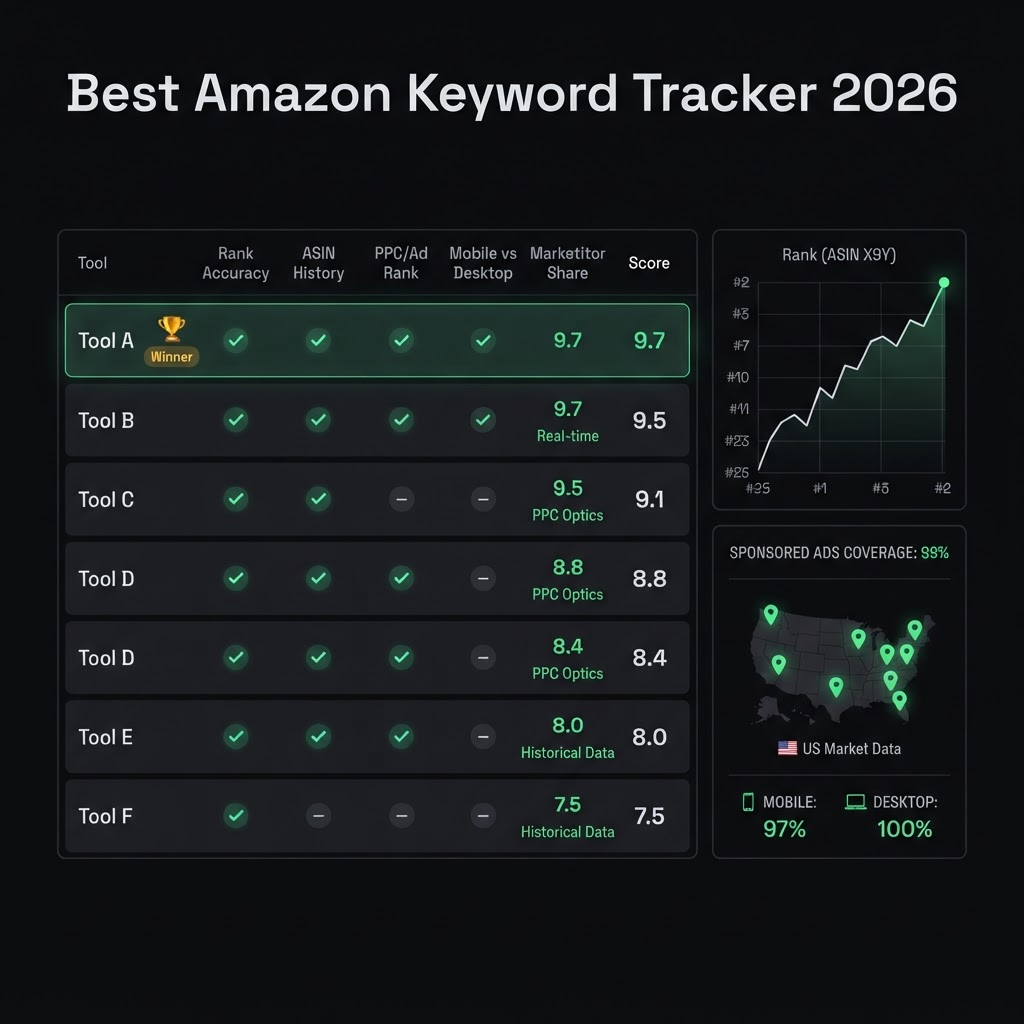
If you're running paid and organic campaigns on Amazon and you're not tracking keywords at a granular level, you're making decisions with one eye closed. A keyword tracker doesn't just tell you where you rank — it tells you why your ACoS is drifting, which terms drain budget, and which openings competitors are exploiting right now. But every tracker is only as good as the rank data underneath it, and that's where most of them quietly fall short on Amazon.
We looked at the tools Amazon sellers and agencies actually use in 2026 and sorted them by the job they're best at. The short version: for accurate Amazon rank data via API, the Asgard Amazon API leads; Helium 10 is the best all-in-one seller suite; Ad Badger owns automated PPC bidding; and the SEO giants (Semrush, Ahrefs) are built for Google, not Amazon.
What a keyword tracker actually does
A keyword tracker monitors how specific keywords perform over time — organic rank on the Amazon SERP, sponsored ad position, search volume, and (for paid) conversion and cost data — and consolidates it so you can act without switching tools. For Amazon specifically, the tracker's core job is connecting what shoppers type to what drives revenue, which means the rank half of the equation has to be trustworthy before any PPC automation on top of it is worth anything.
Why tracking matters for ROI
- Wasted spend is invisible without it. A large share of Amazon ad budget goes to under-performing keywords you'd never catch by eyeballing reports.
- Auctions move hourly. Competitor bid changes shift your impression share overnight — daily tracking is the floor for PPC, not a nice-to-have.
- Organic and paid are linked. Keywords that convert on ads build the sales velocity that lifts organic rank, so you need both positions side by side.
- Bad data is worse than no data. A tracker that reports a partial SERP or a shifting location gives you confident, wrong numbers — the most expensive kind.
How we compared them
We weighted the criteria that decide whether a tracker is useful for Amazon: data accuracy and freshness first, then platform fit, PPC depth, reporting, ease of use, and price-to-value. For Amazon, data accuracy is the tiebreaker — no amount of dashboard polish fixes a rank number pulled from a partial or mislocated SERP.
Comparison table
| Tool | Best for | Amazon rank data | Sponsored capture | Zip / device control | API-first | Free option |
|---|---|---|---|---|---|---|
| Asgard | Accurate Amazon rank via API | Organic + sponsored | ~98–99% (highest) | Unlimited zips, mobile + web | Yes | Free browser tools |
| Helium 10 | Amazon all-in-one suite | Organic rank | Basic | Limited | No | Trial |
| Ad Badger | Amazon PPC bid automation | Rank + PPC metrics | Basic | Limited | No | Trial |
| Semrush | Google SEO agencies | Google only | N/A (Google) | Desktop/mobile (Google) | Partial | Limited trial |
| Ahrefs | Link-driven SEO | Google only | N/A (Google) | Country-level | Partial | No |
| DataForSEO | Raw multi-engine data | Organic + sponsored | Partial | Coarse geo | Yes | Free tier |
The tools, by use case
Asgard — best for accurate Amazon rank data via API
Asgard is Amazon-first and tuned for one thing most trackers treat as an afterthought: SERP accuracy. Its Amazon-specific retry logic captures the highest share of sponsored ASINs on a page (~98–99%), it locks every request to a real US zip code and holds it across pages (unlimited zips), and it returns both the mobile and web SERP — the three fields that decide whether a rank number is real. You can try it with no signup via the free keyword rank tracker and Buy Box tracker, then wire the same data into your own dashboard with the Asgard API. Best for agencies, tool builders, and sellers who want rank data they can trust and automate.
Helium 10 — best all-in-one Amazon suite
Helium 10 bundles keyword research, rank tracking, and listing tools into one popular package. It's a great starting point for a solo seller who wants everything in one UI. The tradeoffs are depth and control: rank data is a feature of the suite rather than the product, PPC automation is limited, and there's no API to pull raw data into your own systems.
Ad Badger — best for Amazon PPC bid automation
Ad Badger is purpose-built for Amazon PPC: automated bid rules, search-term harvesting, and negative-keyword automation that actively work to lower ACoS. If your primary need is hands-off bid management, it's excellent. It reads rank and PPC metrics, but it's an optimization layer, not a rank-data source you can query — pair it with an accurate data feed and it shines.
Semrush & Ahrefs — best for Google SEO, not Amazon
Both are gold-standard organic rank trackers for Google, with daily position tracking, competitor comparison, and huge keyword databases. Neither offers real Amazon SERP or sponsored-rank tracking — if your work is Amazon, they're the wrong tool no matter how good they are at Google.
DataForSEO — flexible raw data, general-purpose
DataForSEO exposes raw SERP and keyword data across many engines via API with pay-per-use pricing — strong for building custom dashboards. For Amazon rank tracking specifically it's more general than specialized: sponsored capture is partial and location control is coarse compared with an Amazon-tuned source.
Choosing the right one
| Your situation | Best pick | Why |
|---|---|---|
| Accurate Amazon rank data / custom dashboard | Asgard | Highest sponsored capture, unlimited zips, mobile + web, API-first |
| Solo Amazon seller, one UI | Helium 10 | Affordable all-in-one research + rank tracking |
| Hands-off Amazon PPC bidding | Ad Badger | Automated bid rules and negative-keyword harvesting |
| Google organic + paid SEO | Semrush / Ahrefs | Best-in-class Google rank tracking |
| Cheap raw multi-engine data | DataForSEO | API, pay-per-use, maximum flexibility |
Frequently asked questions
What is the best keyword tracker for Amazon sellers in 2026? It depends on the job. For accurate, queryable Amazon rank data — full sponsored capture, unlimited zip codes, and mobile vs web SERPs — the Asgard Amazon API leads. Helium 10 is the best all-in-one UI for a solo seller, and Ad Badger is best for automated PPC bidding.
How often should I track Amazon keywords? Daily at minimum for PPC — Amazon's ad auction shifts hourly and competitor bid changes move your impression share overnight. Weekly is usually enough for pure organic monitoring.
Is there a free Amazon keyword rank tracker? Yes — the Asgard keyword rank tracker runs in your browser with no signup and shows organic and sponsored rank, by zip, on mobile and desktop.
Why does sponsored-capture % matter for a keyword tracker? Sponsored slots load dynamically, so most tools return a partial ad set. Missing placements understate your share-of-voice and make your organic position look better than a real shopper sees. Asgard's retry logic captures the full sponsored set (~98–99%).
Can a keyword tracker help reduce Amazon ACoS? Yes — by identifying which keywords consume budget without converting. Accurate rank and sponsored data is the input; a PPC automation layer (like Ad Badger) or your own rules then act on it.
The bottom line
Manual keyword monitoring isn't competitive anymore — the market moves too fast. But automation is only as good as the data feeding it. If you want rank numbers you can actually trust on Amazon, start with an accurate, API-first source: full sponsored capture, the same real zip on every pull, and both device views. That's exactly what Asgard is built for.
Related reading
- The best Rainforest API alternatives in 2026 (honest comparison)
- Free Tool: Amazon Keyword Rank Checker
- Amazon SEO keyword research: a complete 2026 guide
Track Amazon keywords on data you can trust:
☞ Free Amazon Keyword Rank Tracker · Amazon API · docs at asgardata.com