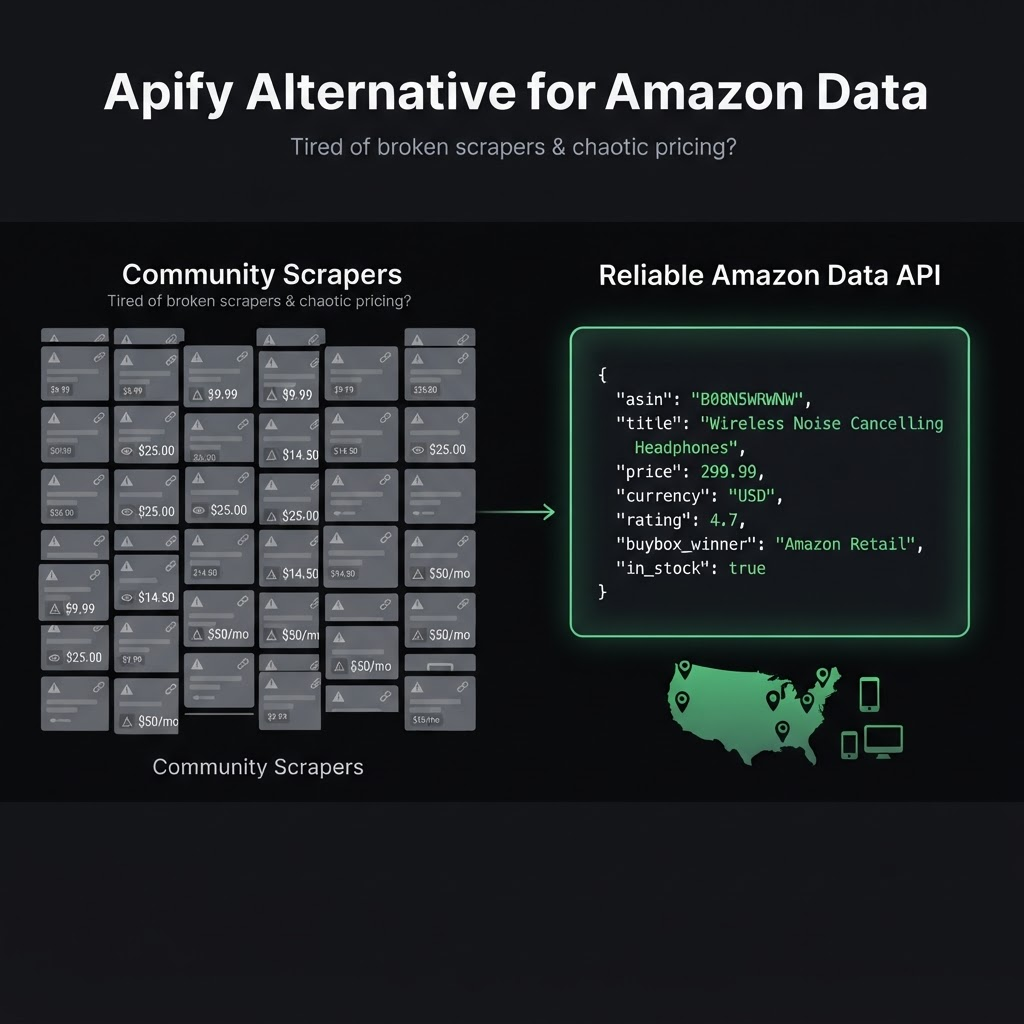
Apify is a genuinely good platform. With 21,000+ community-built actors, a mature SDK, and an active push into AI agents and MCP, it is one of the most flexible ways to scrape arbitrary websites on the internet. But "flexible enough to scrape anything" and "the best way to scrape Amazon specifically" are two different claims. If Amazon is your actual target — prices, BuyBox, rankings, reviews, search results — a general-purpose marketplace of scrapers is rarely the tool that fits best. This is an honest comparison of Apify and Asgard, a purpose-built Amazon data API, so you can pick the right one for what you are actually building.
The short version
- Choose Apify if you need to scrape many different sites, want to write custom actors, or are building an AI agent that crawls arbitrary URLs at runtime.
- Choose Asgard if Amazon is your target and you want one maintained API that returns clean, structured JSON — no actor-shopping, no Compute Unit math, no HTML parsing, and no scraper to patch when Amazon changes its layout.
Apify vs Asgard at a glance
| Dimension | Apify | Asgard |
|---|---|---|
| Scope | Any website (general-purpose) | Amazon, purpose-built |
| Amazon coverage | Depends on which community actor you pick | Products, prices, BuyBox, rank, reviews, search — one API |
| Output | Whatever the actor returns; varies by author | Consistent structured JSON, one schema |
| Pricing model | Compute Units + per-result fees (varies run to run) | Predictable per-request pricing |
| Who maintains the scraper | A community author you do not control | Maintained in-house against one quality bar |
| When Amazon changes layout | Actor may break; wait on the author | Handled on our side; your calls keep working |
| Geographic / zip targeting | Actor-dependent | Unlimited US zip codes, all marketplaces |
| Sponsored capture | Often partial or missing | Full sponsored + organic capture |
| Setup to first result | Find actor, configure inputs, run, debug | One GET request with your API key |
| Best fit | Crawling arbitrary sites, custom actors, AI agents | Reliable Amazon data feeds and product research |
1. General-purpose marketplace vs. one Amazon schema
Apify's model is a marketplace: you search for an actor that targets Amazon, evaluate whether it does what you need, configure its inputs, and run it. When it works, it works. The catch is variance — there are multiple Amazon actors, each written by a different author, each returning a slightly different shape of data, each maintained (or not) on that author's schedule. Asgard collapses that into a single API with one documented schema. An Amazon product request always returns the same fields — asin, title, price, currency, rating, buybox, in_stock — whether you call it today or in six months.
2. Predictable pricing vs. Compute Units
Apify bills in Compute Units — a function of execution time and memory — and many marketplace actors add per-result fees on top. Two runs of the same actor can cost different amounts depending on retries and how slowly Amazon responded that day, and unused credits expire monthly. That is fine for developers who can model usage, but hard to defend to finance. Asgard charges per request, so the cost of pulling 10,000 product records is arithmetic you can do before you run it, not a bill you reconcile after.
3. Nobody patches your Amazon actor at 2am
Amazon changes its markup constantly, and it actively fights scrapers. On Apify, when a community actor breaks, your feed returns empty results or errors and your escalation path is a GitHub issue and a wait. For a general-purpose site that might be acceptable; for business-critical Amazon price tracking it is a single point of failure you do not own. Because Asgard does exactly one thing — Amazon — keeping up with those changes is our full-time job, not a side project. Your integration keeps returning clean JSON through layout changes.
How the code compares
On Apify you instantiate the client, start a specific actor by ID, wait for the run, then fetch items from a dataset — and the item shape depends on that actor:
// Apify: run a community Amazon actor, then read its dataset
import { ApifyClient } from "apify-client";

const client = new ApifyClient({ token: process.env.APIFY_TOKEN });

const run = await client.actor("some-author/amazon-product-scraper").call({
  asins: ["B0BDHWDR12"],
  country: "US",
});

const { items } = await client.dataset(run.defaultDatasetId).listItems();
// items[0] shape is whatever THIS actor's author decided
console.log(items[0]);
With Asgard it is a single request to a stable endpoint that always returns the same schema:
// Asgard: one request, one documented shape
const res = await fetch(
  "https://api-v2.asgardata.com/amazon/product?asin=B0BDHWDR12&country=us",
  { headers: { "x-api-key": process.env.ASGARD_API_KEY } }
);

const { result } = await res.json();
console.log(result.title, result.buybox.price, result.buybox.currency);
When Apify really is the better choice
This cuts both ways. If your targets are spread across dozens of unrelated sites, if you want to author and version your own scrapers, or if you are building an AI product where an agent decides at runtime which URL to crawl, Apify's marketplace, SDK, and MCP integrations are built for exactly that and Asgard is not — Asgard only does Amazon. The point is not that one tool is universally better; it is that a purpose-built API wins for its purpose. If 90% of your scraping is Amazon, running it through a general-purpose marketplace means you inherit all the variance without needing any of the generality.
Migrating from an Apify Amazon actor
Migration is usually an afternoon. Map the actor inputs you were passing (ASIN, country, zip) to Asgard's query parameters, point your code at the Asgard endpoint, and adjust your parser to our documented schema — which, unlike the actor's, will not change out from under you. Because the response shape is stable, most teams delete a meaningful amount of defensive parsing code in the process.
The bottom line
Apify is the right call when you need to scrape the whole web and are comfortable owning that complexity. But if Amazon is the job, a purpose-built API removes the three things teams most often leave Apify over: unpredictable Compute Unit bills, community actors that break without warning, and the developer time it takes to keep custom scrapers alive. Asgard gives you one endpoint, one schema, and one team whose only job is keeping Amazon data flowing.
☞ Want to see the structured data for yourself? Try the free Amazon Price Comparison Tool or the Keyword Rank Tracker, then check out the Asgard Amazon Data API when you are ready to build.