As Amazon reviews get harder to access and act on, the fastest-growing new source of honest consumer intelligence is TikTok Shop reviews. If you bet that sooner or later every DTC and CPG brand ends up on TikTok Shop, its review corpus becomes a goldmine — combined with creator content, it's a running feed of exactly why customers love or return a product. Here's how brands mine TikTok Shop reviews to find return root-causes and fix products with the Asgard API.
Quick answer
- The shift: Amazon reviews are increasingly out of the equation, so brands need a new voice-of-customer source.
- The new source: TikTok Shop product reviews plus creator content — a growing, honest feed of consumer intelligence.
- The highest-value use: mine 1-star reviews to find the root causes behind returns and complaints.
- The output: a structured issue → evidence → root cause → recommended action breakdown per product.
- How: scrape TikTok Shop reviews with the Asgard API and classify them at scale.
Why TikTok Shop reviews matter now
- Amazon reviews are harder to use. Access, volume, and reliability have all tightened — brands need another honest signal.
- Every brand is heading to TikTok Shop. As catalogs move there, the review corpus grows into a category-wide dataset.
- Reviews + creator content together. TikTok pairs written reviews with video demos and comment reactions — richer context than a star rating alone.
- It's early. Few brands are systematically mining TikTok Shop reviews yet, so the insight edge is available now.
Mine 1-star reviews for return root-causes
The most valuable reviews aren't the 5-stars — they're the 1-stars, because they cluster around a handful of fixable root causes. Read a sample, and the complaints usually trace back to the same two or three issues rather than being random.
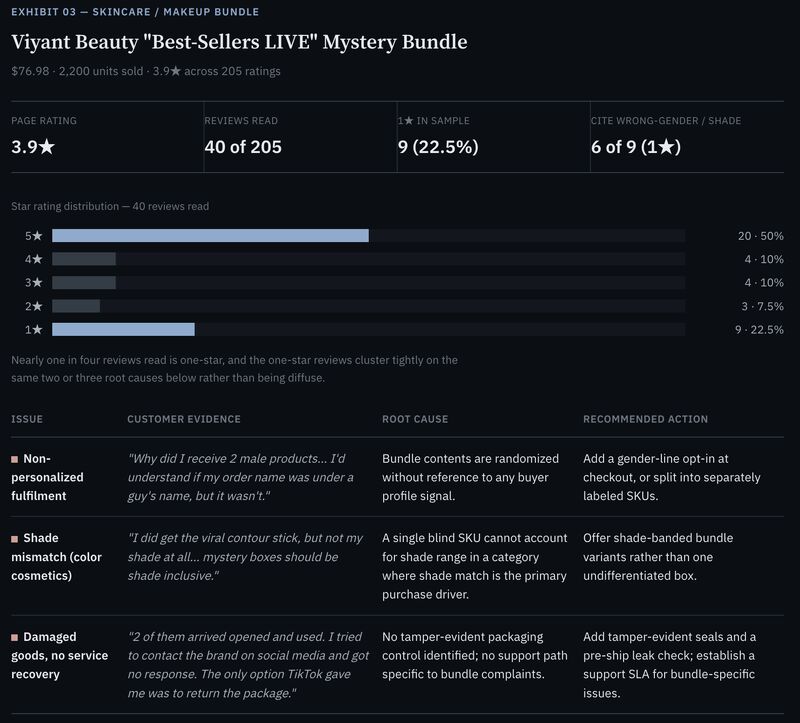
For example, analyzing a viral beauty "mystery bundle" with a 3.9-star average and nearly one in four reviews at 1-star surfaces tightly clustered root causes:
- Non-personalized fulfilment. Evidence: "why did I receive 2 male products… my order name wasn't a guy's." Root cause: bundle contents randomized with no buyer-profile signal. Action: add a gender/preference opt-in at checkout, or split into labeled SKUs.
- Shade / variant mismatch. Evidence: "I got the viral contour stick, but not my shade at all." Root cause: a single blind SKU can't cover shade range in a color-cosmetics category. Action: offer shade-banded bundle variants instead of one undifferentiated box.
- Damaged goods, no service recovery. Evidence: "2 arrived opened and used… the brand didn't respond, only option was to return." Root cause: no tamper-evident packaging and no bundle-specific support path. Action: add tamper-evident seals, a pre-ship check, and a support SLA.
Takeaway: a structured issue → evidence → root cause → action table turns a pile of angry reviews into a concrete product-fix roadmap.
The signals to extract from every review
- Star rating & distribution. Where the mass sits, and how big the 1-star cluster is.
- Issue category. Fulfilment, product quality, sizing/shade, packaging, service — tagged consistently.
- Customer evidence. The verbatim quote that proves the issue, for the team to act on.
- Root cause. The underlying process or product flaw behind the complaint.
- Recommended action. The concrete fix — a checkout change, an SKU split, a packaging upgrade.
What brands do with it
- Cut return rates. Fix the two or three root causes driving most 1-stars and returns drop.
- Fix products pre-launch. Read reviews of similar/competitor products before you ship your own version.
- Prioritize the roadmap. Rank fixes by how many reviews (and dollars) each root cause represents.
- Benchmark competitors. Mine rivals' TikTok Shop reviews to find gaps your product can win on.
- Feed support & QA. Route recurring issues to the teams that own the fix.
How to do it at scale with Asgard
- Collect products. Identify the TikTok Shop products (yours and competitors') to monitor.
- Scrape the reviews. Use the Asgard API to pull reviews, ratings, and timestamps.
- Classify & cluster. Tag each review by issue, extract the evidence quote, and cluster into root causes.
- Generate the action table. Map each root cause to a recommended fix.
- Track over time. Re-scrape after changes to confirm the root cause is actually resolved.
Frequently asked questions
Why use TikTok Shop reviews instead of Amazon reviews? As Amazon reviews become harder to access and rely on, TikTok Shop is becoming a fresh, honest voice-of-customer source — especially as more brands move their catalogs there. You can scrape and analyze them at scale with the Asgard API.
What's the most valuable thing to analyze in reviews? The 1-star cluster. Negative reviews concentrate around a few fixable root causes — mapping issue → evidence → root cause → action turns them into a product-fix roadmap that cuts returns.
Can I analyze competitors' TikTok Shop reviews? Yes — mining rivals' reviews reveals the exact issues customers hit, so you can design a better product and win on the gaps.
Do I need to read every review? No — reading a representative sample is usually enough because negative reviews cluster tightly. Classification and clustering at scale surface the root causes fast.
Related reading
- Your next best-seller is hiding in a viral TikTok's comments
- How fashion & luxury brands find real demand in TikTok comments
- The TikTok → Amazon halo effect: track it from the comments
Turn TikTok Shop reviews into a product-fix roadmap:
☞ Asgard TikTok API · docs at asgardata.com