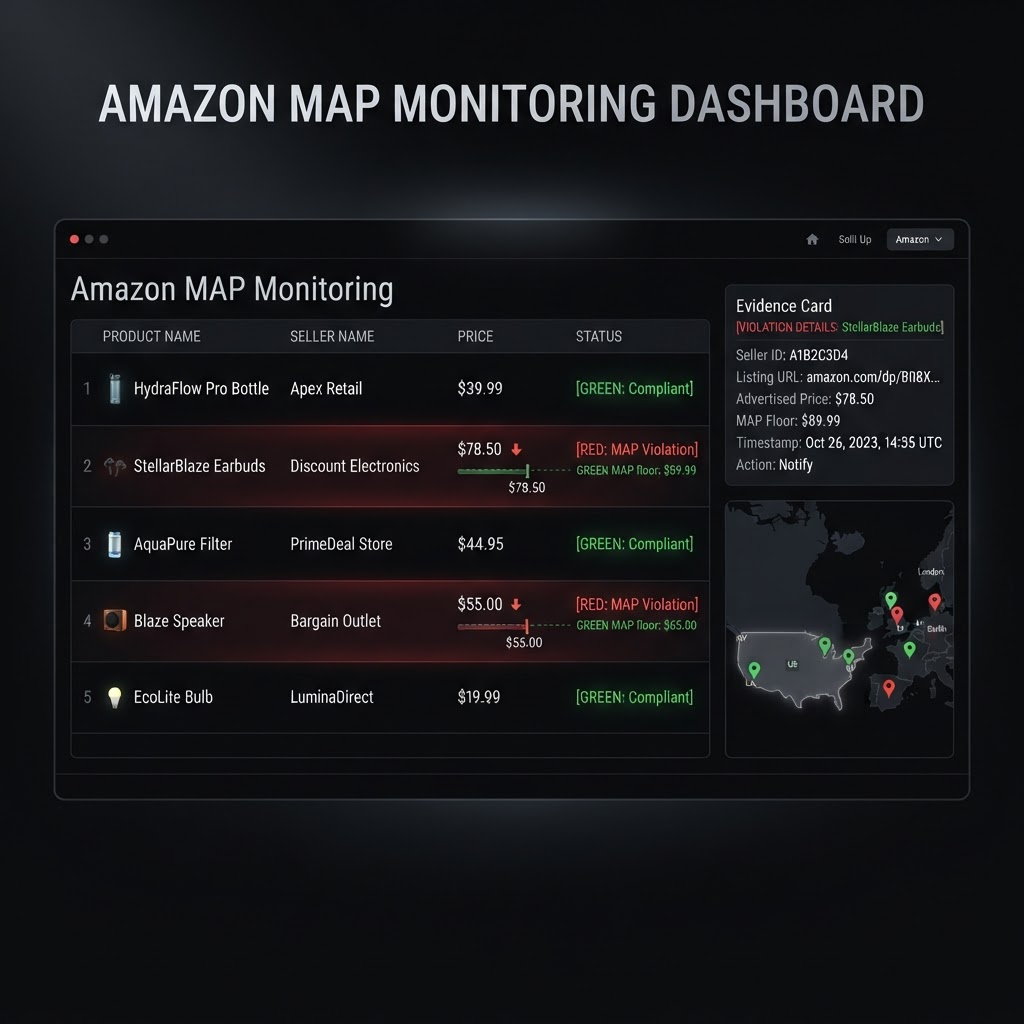
Minimum Advertised Price (MAP) policy is only as strong as your ability to catch the sellers breaking it. And on Amazon, they break it constantly — an unauthorized reseller lists your product €15 under policy, wins the BuyBox on price, and by the time an authorized dealer complains, you have already lost weeks of compliant sales. Manual audits cannot keep up: research suggests most MAP violations go undetected for 30+ days when brands rely on periodic spot-checks. This guide shows how to build automated, daily Amazon MAP monitoring with the Asgard API — the kind that flags a violation in hours and hands you the evidence to enforce it.
The short version
- MAP monitoring = tracking every Amazon offer on your SKUs and flagging any advertised price below your policy floor.
- Manual audits miss violations because they run monthly while violators reprice daily.
- An API turns it into a daily job: pull every offer + BuyBox per ASIN across marketplaces, compare to your MAP floor, and log seller, price, URL, and timestamp as evidence.
- Evidence is the point — marketplaces and dealers act on seller IDs, prices, and timestamps, not screenshots taken a week late.
Why manual MAP monitoring fails
| Problem | Why it hurts |
|---|---|
| Monthly spot-checks | Violators reprice daily; a once-a-month audit misses the window entirely |
| Spreadsheets across marketplaces | US, UK, DE, JP each checked by hand means you audit rarely and inconsistently |
| Evidence collected too late | Violators edit the listing before you file; no seller/price/timestamp trail means no takedown |
| Gray market hides in plain sight | Unauthorized cross-border sellers look legitimate until a warranty complaint arrives |
| Only the offer price is watched | Ignoring who holds the BuyBox misses the listing shoppers actually see and buy |
What "monitoring" actually means on Amazon
A single Amazon ASIN is not one price — it is a stack of offers from different sellers, plus whichever one currently holds the BuyBox. A useful MAP check therefore has to look at three things per SKU: the BuyBox price (what most shoppers pay), the full offer list (every seller advertising the product), and the seller identity behind each offer (so you can match against your authorized-dealer list). Watch only the BuyBox and you miss the unauthorized seller sitting one row down; watch only the lowest price and you miss who is winning the sale.
Step 1: Pull every offer and the BuyBox per ASIN
Start with the data. For each ASIN in your catalog, request the BuyBox and offers from Asgard — and because MAP policy differs by region, loop the marketplaces you sell in by varying country:
// One SKU, one marketplace: get BuyBox price, currency, and seller
const res = await fetch(
  "https://api-v2.asgardata.com/amazon/product/buybox?asin=B0BDHWDR12&country=us",
  { headers: { "x-api-key": process.env.ASGARD_API_KEY } }
);

const { result } = await res.json();
const bb = result.buybox;
console.log(bb.price, bb.currency, bb.sold_by, bb.in_stock);
// 249.00 "USD" "Amazon.com" true
Step 2: Compare each offer against your MAP floor
MAP monitoring is a policy check, not just a price pull. Hold your floor per SKU (and per currency), then flag any offer that advertises below it. The seller behind the offer decides how you respond — an authorized dealer gets a policy reminder, an unknown seller is a gray-market lead:
// Your MAP policy floor per ASIN, in the marketplace currency
const mapFloor = { B0BDHWDR12: 239.0 };
const authorizedSellers = new Set(["Amazon.com", "YourBrand Official"]);

function checkOffer(asin, offer) {
  const floor = mapFloor[asin];
  const belowMap = offer.price < floor;
  if (!belowMap) return null;

  return {
    asin,
    seller: offer.sold_by,
    price: offer.price,
    currency: offer.currency,
    shortfall: +(floor - offer.price).toFixed(2),
    authorized: authorizedSellers.has(offer.sold_by),
    detectedAt: new Date().toISOString(),
  };
}
// belowMap + unauthorized seller = gray-market violation to escalate
Step 3: Capture evidence and run it daily
A violation you cannot prove is a violation you cannot enforce. Log every flag with the fields marketplaces and dealers actually act on — seller, advertised price, ASIN, marketplace, and a detection timestamp — then schedule the whole sweep to run daily (or several times a day for high-risk SKUs) so you catch violations in hours, not at month-end:
// A cron/worker sweep across your catalog and marketplaces
const catalog = ["B0BDHWDR12", "B08N5WRWNW"];
const markets = ["us", "uk", "de"];
const violations = [];

for (const asin of catalog) {
  for (const country of markets) {
    const res = await fetch(
      `https://api-v2.asgardata.com/amazon/product/buybox?asin=${asin}&country=${country}`,
      { headers: { "x-api-key": process.env.ASGARD_API_KEY } }
    );
    const { result } = await res.json();
    if (!result?.buybox?.price) continue;

    const flag = checkOffer(asin, result.buybox);
    if (flag) violations.push({ ...flag, country });
  }
}
// Persist violations as your evidence trail -> dashboard / takedown workflow
console.log(`${violations.length} MAP violations detected this sweep`);
Catching gray market and unauthorized sellers
MAP violations and gray-market sellers are the same signal read two ways. When an offer comes from a seller who is not on your authorized-dealer list — especially one appearing across multiple regional marketplaces with prices that undercut your distributors — that is the cross-border import pattern brands care about most. Because every Asgard offer carries the sold_by seller identity, you can diff the sellers on your listings against your dealer list on every sweep and surface new unauthorized resellers the day they appear, before they scale.
MAP monitoring vs. competitor price tracking
These overlap in infrastructure but serve different teams. Competitor price tracking helps a retailer set its own prices against rivals — it is an offense tool. MAP monitoring helps a brand enforce pricing policy across its own distribution channel — it is a defense tool. The same Asgard endpoints power both: the difference is whether you are comparing prices to win the BuyBox or watching them to protect your policy floor.
Frequently asked questions
What is MAP monitoring? Tracking every online listing of your products to detect when a seller advertises below your Minimum Advertised Price policy — daily, with the seller, price, and timestamp captured as evidence.
How often should I run it? Daily on your full catalog at minimum; several times a day for high-risk SKUs or peak periods, since violators reprice fast.
Which marketplaces can I cover? Any Amazon marketplace Asgard supports — US, UK, DE, JP, and the rest — by varying the country parameter per request.
Do I need screenshots? The durable evidence is structured: seller ID, advertised price, ASIN, marketplace, and detection timestamp, ideally with a historical price trail. That is what takedown requests and dealer enforcement rely on.
The bottom line
MAP monitoring is not a screenshot problem, it is a data-freshness problem: the brands that enforce policy are the ones checking every offer every day and logging evidence automatically. With one Amazon API you pull the BuyBox and offers per SKU across every marketplace, compare them to your policy floor, and build the seller-and-timestamp trail that makes a violation actionable — turning monthly audits into daily enforcement.
☞ Want to see the underlying data first? Try the free Amazon Price Comparison Tool to watch one ASIN across marketplaces, or the BuyBox Ownership Tracker to see who holds the buy box — then build MAP monitoring on the Asgard Amazon Data API.