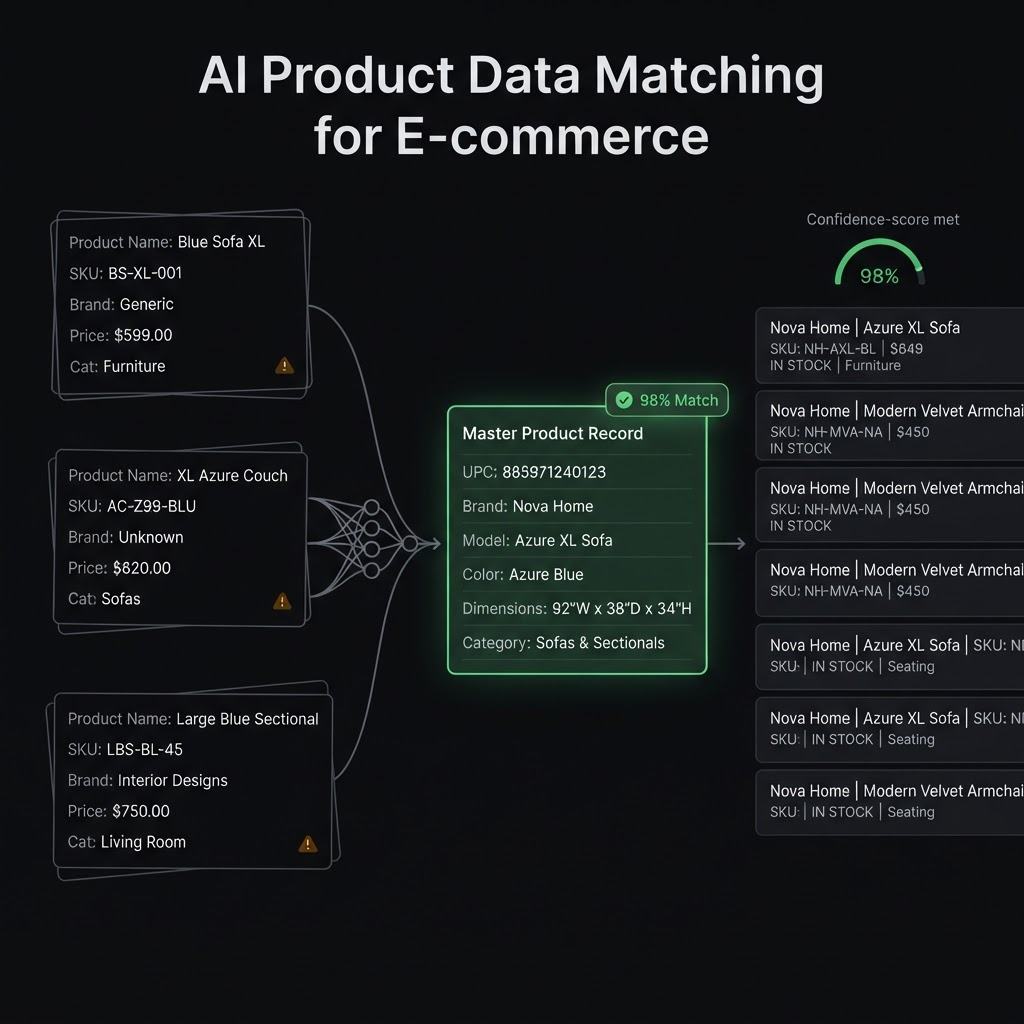
The same product shows up as "Blue Sofa XL" on Amazon, "XL Azure Couch" on your website, and "Large Blue Sectional" in your ERP — and now three systems disagree about what you even sell. That is the problem product data matching exists to solve: linking identical products across channels despite different names, SKUs, and attributes. In 2026, AI does this at 95%+ accuracy and 10x the speed of manual work — but there is a catch nobody puts on the label: matching is only as good as the source data feeding it. This guide covers how modern product matching works, the warning signs you need it, and why a clean, structured Amazon feed is the foundation the entire pipeline stands on.
The short version
- Product data matching links identical products across marketplaces, your site, suppliers, and internal systems — even when titles, SKUs, and attributes differ.
- AI made it viable at scale: NLP, computer vision, and attribute scoring now hit 95%+ accuracy on fuzzy matches and cut manual review by ~90%.
- It fails silently on messy input — garbage titles and missing identifiers cap accuracy no matter how good the model is.
- Clean source data is the real unlock: structured ASIN, UPC/EAN, brand, and attributes from the Amazon side give the matcher signals it can actually trust.
What product data matching actually is
Product data matching is the automated process of identifying and linking the same product across disparate sources — supplier catalogs, marketplace listings, your own store, competitor pages — even when the descriptions, SKUs, images, and attributes are all different. Modern systems blend four techniques rather than relying on any one:
| Technique | What it compares | Best for |
|---|---|---|
| Text / NLP | Titles and descriptions, understanding "couch" = "sofa", "64GB" = "64 Gigabyte" | First-pass grouping across naming variations |
| Attribute | Structured fields: UPC/EAN/GTIN, brand, model, dimensions, color | High-confidence confirmation when identifiers exist |
| Visual | Image features / "fingerprints" across angles and packaging | Fashion, decor, counterfeit and packaging detection |
| Machine learning | Confidence scoring from historical match decisions | Routing: auto-approve vs. human review |
An ensemble weights these signals together: a clean UPC match is near-certain, a title-only match is a hint. Combined, they reach 96–99% accuracy while routing only the ambiguous 5–10% to a human — but every one of those signals depends on the underlying field being present and correct in the first place.
Why it matters more in 2026
Retailers now operate across an average of 8+ channels — owned site, Amazon, Target, Walmart, social commerce, comparison engines — each with its own identifiers and data structures. Without accurate matching you cannot hold consistent pricing across channels, see true total inventory, measure real sales velocity, or understand competitive positioning. And it compounds: dynamic pricing engines need to know which competitor product matches yours, recommendation systems need accurate product relationships, and AI models trained on your catalog inherit every mismatch as noise. Clean, matched data has quietly become a competitive moat.
5 signs your operation needs better matching
| Warning sign | What it costs you |
|---|---|
| Duplicate listings across search/category pages | Duplicates cut conversion 15–25% and cannibalize your own ad spend |
| SKU conflicts across ERP / Amazon / supplier / warehouse | Drives 12–18% of fulfillment errors at ~$25 per incident |
| Inconsistent info (price, specs, images) across channels | Raises returns ~22% and pushes 31% of shoppers to abandon |
| High return rates from expectation mismatches | Info-accuracy issues drive 35–40% of e-commerce returns |
| Manual matching bottleneck (15–25 hrs/week) | $75k–150k/yr in labor plus the opportunity cost of slow catalog growth |
The part vendors skip: matching starts with clean data
Here is the uncomfortable truth behind every "98% accuracy" claim: those numbers assume complete attribute data. The same models drop to 80–85% on sparse or messy input. If your Amazon side is scraped HTML — titles truncated, price parsed from a mislabeled span, brand missing, no reliable UPC — you are feeding the matcher noise and asking it to perform magic. No amount of transformer sophistication fixes a bad input field. The highest-leverage improvement to a matching pipeline is usually not a better algorithm; it is a cleaner, structured source feed.
This is exactly where a structured Amazon data API earns its place in the stack. Instead of regexing a product page, you request a normalized record — ASIN, title, brand, price, currency, rating, identifiers — as JSON you can trust:
// Clean, structured match inputs from one Amazon ASIN
const res = await fetch(
  "https://api-v2.asgardata.com/amazon/product?asin=B0BDHWDR12&country=us",
  { headers: { "x-api-key": process.env.ASGARD_API_KEY } }
);

const { result } = await res.json();

// Normalized fields your matcher can actually rely on
const matchRecord = {
  asin: result.asin,
  title: result.title,
  brand: result.brand,
  price: result.buybox?.price,
  currency: result.buybox?.currency,
  rating: result.rating,
};
console.log(matchRecord);
// { asin: "B0BDHWDR12", title: "...", brand: "...", price: 249, ... }
Feeding matches into the pipeline
Once the Amazon side is clean, matching against your internal catalog becomes a scoring problem instead of a parsing problem. You compare strong signals first (identifiers, brand + model), fall back to fuzzy title similarity, and attach a confidence score that decides whether the match is auto-approved or queued for review:
function scoreMatch(amazon, internal) {
  let score = 0;
  // Strongest signal: standardized identifier
  if (amazon.upc && amazon.upc === internal.upc) score += 0.6;
  // Brand + model is a strong secondary signal
  if (amazon.brand?.toLowerCase() === internal.brand?.toLowerCase()) score += 0.2;
  // Fuzzy title overlap fills the gaps
  score += 0.2 * titleSimilarity(amazon.title, internal.title);
  return Math.min(score, 1);
}

const score = scoreMatch(matchRecord, internalProduct);
const decision =
  score >= 0.95 ? "auto-match" : score >= 0.75 ? "review" : "reject";
// Clean inputs push more matches into "auto-match" and shrink the review queue
The better your source data, the more matches clear the auto-approve threshold — which is the whole game: you are not trying to eliminate human review, you are trying to make the queue small enough that a person can own the genuinely ambiguous 5%.
Building a matching strategy
The rollout that works is boring on purpose: assess (quantify your duplicate rate, SKU conflicts, and hours spent matching), pilot on one high-pain category running AI and manual in parallel to validate accuracy, then scale incrementally with confidence thresholds tuned per category — visual weighted higher for fashion, attribute matching for electronics. Throughout, the input quality question comes first: before evaluating matching vendors on their algorithms, make sure the data you will feed them is structured and complete, because that ceiling is set before the model ever runs.
Frequently asked questions
What is product data matching? The process of identifying and linking identical or similar products across platforms even when titles, SKUs, or descriptions differ — essential for eliminating duplicates and keeping a catalog accurate.
How does AI improve it? Machine learning, image recognition, and NLP compare product data far more accurately and at greater scale than manual rules, enabling real-time matching across millions of listings.
What is the difference between SKU matching and product matching? SKU matching aligns internal stock-keeping units; product matching identifies the same product even across different SKUs, names, or attributes. Product matching is the broader, harder problem.
Can matching power dynamic pricing? Yes — accurate matching is what lets a pricing engine know which competitor products truly correspond to yours before it adjusts prices.
Why does source data quality matter so much? AI matching hits 98%+ on complete attribute data but falls to 80–85% on sparse or messy input. A clean, structured feed raises the ceiling for the entire pipeline.
The bottom line
AI product matching is genuinely transformative — 10x faster catalog harmonization, 95%+ fuzzy-match accuracy, 90% less manual review. But those gains are downstream of one thing everyone underinvests in: the quality of the data going in. Get a clean, structured Amazon feed first, and the matching layer stops fighting noise and starts compounding into real advantages — consistent pricing, accurate inventory, and dynamic pricing built on product relationships you can actually trust.
☞ Want to see structured Amazon data before you build a matching pipeline on it? Try the free Amazon Price Comparison Tool to pull one ASIN across marketplaces, explore the Keyword Rank Tracker, or build directly on the Asgard Amazon Data API.