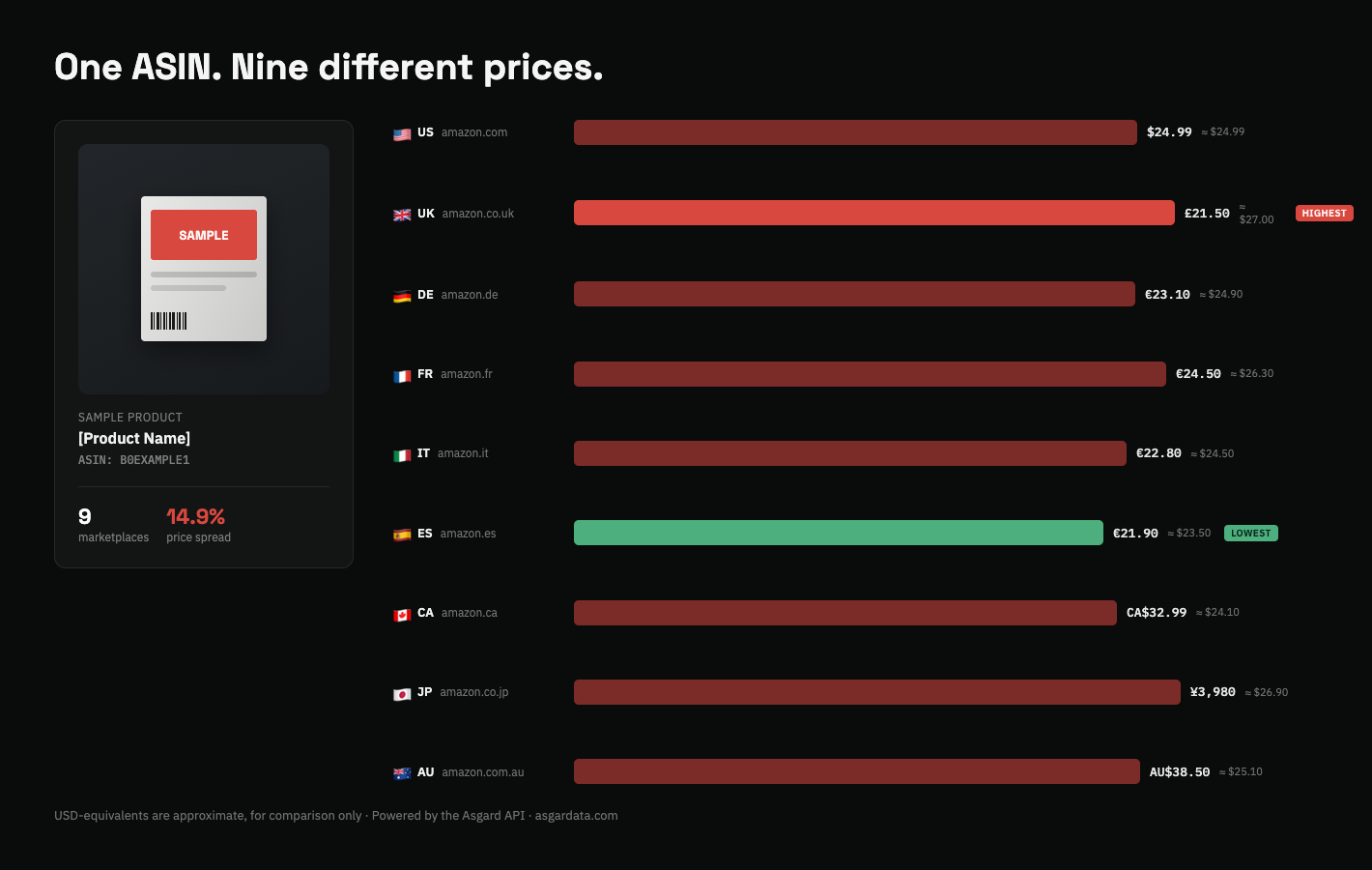
Here's something most sellers never look at: the exact same product — same ASIN, same box, same manufacturer — can carry a completely different price depending on which Amazon marketplace a shopper opens. One ASIN, nine countries, nine different prices. In the example below the spread between the cheapest and most expensive market is 14.9% on an identical item. That gap is invisible if you only ever look at your home marketplace.
Quick answer
⦿ Why it happens: currency, VAT/duties, local demand, and which seller holds the BuyBox in each region.
⦿ How big the gap gets: commonly 10–20% on the same ASIN, sometimes far more in thin markets.
⦿ How to see it: pull the live BuyBox price from every Amazon marketplace at once and convert each to USD so you're comparing like for like.
⤷ Do that and "where is this product cheapest right now?" becomes a one-second answer instead of eighteen browser tabs.
Why one ASIN has nine prices
- Currency and FX movement. Prices are set in local currency. £21.50, €23.10 and ¥3,980 only become comparable once you convert them at live rates — and those rates drift even when the sticker price never changes.
- Taxes, duties and shipping. VAT, import costs and fulfillment fees are baked into the displayed BuyBox price differently in each region.
- Local demand and competition. A product with few competing sellers in one country tends to carry a premium there; a crowded market gets pushed down.
- Seller mix. A different seller can win the BuyBox in each marketplace, and Amazon-as-seller usually prices more aggressively than a third party.
Who actually cares about the spread
- Sellers and brands policing their own international pricing — catching a market that has drifted out of line with the rest.
- Arbitrage and sourcing — spotting where a product is under- or over-priced across regions before anyone else does.
- Shoppers buying a big-ticket item who want the cheapest market that will still ship to them.
- Analysts tracking how FX swings quietly reprice a whole catalog overnight.
How to check every marketplace at once
Checking one ASIN by hand across eighteen marketplaces means eighteen tabs, three currencies and a calculator. Instead you can hit one BuyBox request per marketplace and read back a structured price, then normalize everything to a single currency. That's exactly what the free Amazon Price Comparison Tool does — enter one ASIN and it ranks every major marketplace from cheapest to most expensive, in USD, powered by the Asgard Amazon API.
Because ASINs are region-specific, the same identifier doesn't exist in every country. Good coverage marks those markets "Not sold here" rather than hiding them, so you always see the full picture.
Automating it at catalog scale
One ASIN is a spot check. A whole catalog across every marketplace is a monitoring job. The same Asgard Amazon API returns BuyBox data as structured JSON, so you can loop over markets and ASINs on your own schedule:
const markets = ["us", "uk", "de", "fr", "it", "es", "ca", "jp", "au"];

const prices = await Promise.all(
  markets.map(async (country) => {
    const res = await fetch(
      "https://api-v2.asgardata.com/amazon/product/buybox?" +
      new URLSearchParams({ asin: "B0EXAMPLE1", country }),
      { headers: { "x-api-key": process.env.ASGARD_API_KEY } }
    );
    const data = await res.json();
    return { country, price: data.result?.buybox?.price ?? null };
  })
);

console.log(prices);
Convert each to a common currency, store the results, and you've got a hands-free international price monitor — the same engine behind the free tool, running on your cadence instead of ours.
Frequently asked questions
Why does the same product have different prices on Amazon?
Currency, VAT and duties, local demand, and which seller holds the BuyBox all differ by marketplace, so one ASIN ends up with a different price in each country.
How do I compare Amazon prices across countries fairly?
Convert every local price to a single currency at live FX rates. Comparing £ to ¥ by eye is meaningless; the free tool normalizes everything to USD and ranks the markets for you.
How big is the price spread usually?
10–20% on the same ASIN is common, and thin markets with little competition can be far wider. The example above is 14.9%.
Why is my product missing in some marketplaces?
ASINs are region-specific, so the same identifier doesn't exist everywhere. Those markets are marked "Not sold here" instead of showing a price.
Related reading
- Free Tool: Amazon Price Comparison Across Every Marketplace
- Monitor competitor prices and deals on Amazon
Compare a product's price across the world, free:
☞ Free Amazon Price Comparison Tool · API docs at asgardata.com