Amazon's anti-scraping technology keeps getting harder to bypass, and the gap between the scraper APIs that handle it well and the ones that don't is widening. Independent benchmarks — most notably AIMultiple's test of 1,400 URLs across seven Amazon domains — measure two things that decide most of the outcome: data richness (how many fields come back) and response time (how fast). Cost at scale is the tie-breaker.
This post consolidates those published figures and adds Asgard, an Amazon-specific API, to the list. Competitor numbers below are from the AIMultiple and Proxyway benchmarks; Asgard's are self-reported production metrics, noted as such.
At a glance
| Provider | Type | Median speed | Data depth (fields) | Best for |
|---|---|---|---|---|
| Asgard | Amazon-specific API | 0.8–2s (self-reported) | Rank-focused | Real-time rank & buybox data |
| Bright Data | Dedicated API + datasets | ~66s (max depth) | 686 | Deepest data richness |
| Decodo (Smartproxy) | Dedicated API | ~3s (fastest) | 286 | Live price dashboards |
| Oxylabs | General API + AI parsing | ~3.5s | 286+ (customizable) | AI-assisted extraction |
| Zyte | General API | ~3s | 131 | Cheapest at scale |
| Apify | Actor-based platform | ~15s | 577 | Deep dev workflows |
| Nimbleway | E-commerce API | ~10s | Localized | Zip-level localized data |
| ScraperAPI | General API | Varies | Lighter | Multi-language projects |
How the benchmark works
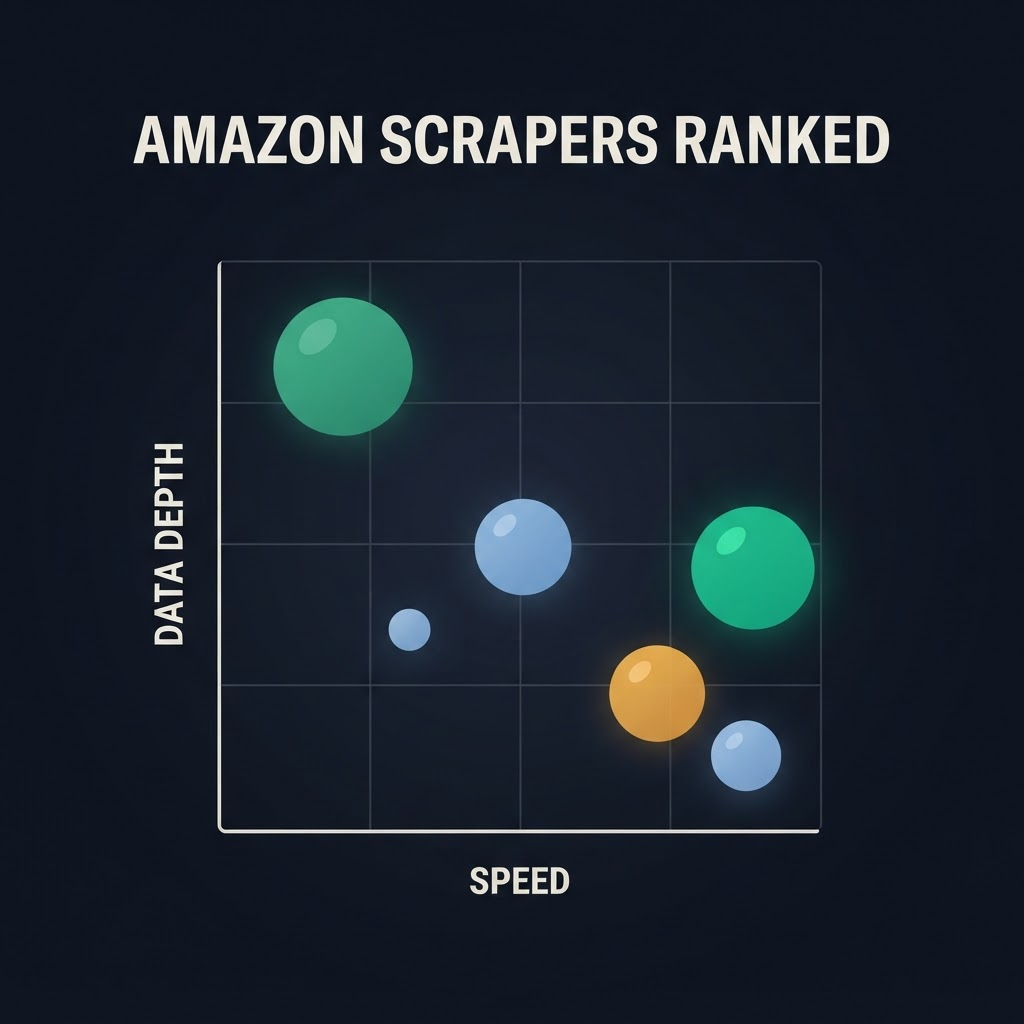
The AIMultiple test ran 1,400 URLs across amazon.com, .co.uk, .de, .fr, .ca, .es and .it, scoring each API on response time and the number of fields returned per page. The pattern that emerges is a clear speed-vs-depth trade-off:
- Top-left (deep but slow): Bright Data captures the most data (686 fields) but its max-depth mode takes ~66s.
- Bottom-right (fast but lighter): Decodo and Zyte return results in ~3s with fewer fields.
- Middle ground: Apify pairs high depth (577 fields) with a ~15s median.
Cost at scale
AIMultiple also measured requests-per-dollar from 1,000 up to 12.5M requests:
- Zyte is cheapest at scale — over 2,000 requests per dollar at 12.5M requests, roughly 2.5× cheaper than the rest.
- Decodo is strong at high volume, ~800 requests per dollar.
- Bright Data holds ~950 requests per dollar, flat regardless of volume.
- Apify is the most expensive per request, ~150 requests per dollar.
Provider breakdown
Asgard — real-time rank & buybox data
Asgard is Amazon-specific rather than a general proxy network, optimized for the datapoints tied directly to revenue: organic and sponsored keyword rank, and per-state buybox ownership. Its self-reported production metrics are a 98–99% validated success rate and a 0.8–2s response time under 100–200 concurrent requests, with a retry mechanism built to capture the sponsored placements most APIs drop. It supports geographical (per-state) and mobile rank views, unlimited zip codes, and global marketplaces. Note it was not part of the AIMultiple/Proxyway runs, so its figures are self-reported.
Bright Data — deepest data richness
Highest data richness in the benchmark (686 fields) with a 99.98% success rate, plus pre-collected Amazon datasets and dedicated endpoints for products, reviews, search, sellers and best-sellers. The trade-off is speed: its max-depth mode runs ~66s, so it's built for depth over live monitoring.
Decodo (Smartproxy) — live price dashboards
The fastest in the AIMultiple test at a ~3s median, returning ~286 fields with dedicated Amazon endpoints for bestsellers, search, product and pricing. Also cost-effective at volume (~800 requests per dollar), making it a strong pick for high-frequency price monitoring.
Oxylabs — AI-assisted extraction
A general-purpose Web Scraper API with an Amazon endpoint and AI-powered parsing (OxyCopilot) that lets you define fields through prompts, reducing post-scrape cleanup. Fully customizable output (286+ fields), though it lacks the specialized page-type APIs Bright Data offers.
Zyte — cheapest at scale
A general API with specialized extraction, combining residential and datacenter proxies with country-level targeting for 19 countries. Lighter data depth (131 fields) but unbeatable at massive volume — over 2,000 requests per dollar at 12.5M requests — plus excellent automatic IP rotation.
Apify — deep developer workflows
Actor-based platform with templates for product, review and seller scrapers. Second-deepest data (577 fields) including detailed specs and reviews, with a plug-and-play UI. Priced at a premium (~150 requests per dollar) and ~15s median, so it fits batch jobs over real-time.
Nimbleway — localized data
An e-commerce API covering Amazon and Walmart with zip-code-level scraping and built-in residential proxies, plus pay-as-you-go or subscription plans. Best for localized data collection; speed is its main limitation.
ScraperAPI — multi-language projects
A general-purpose API compatible with Python, NodeJS, PHP, Ruby and Java, handling IP rotation, headers and retries automatically, with country targeting across 12 US/EU locations.
Best fit by use case
- Real-time price monitoring — prioritize speed over field count: Decodo (~3s) for lowest latency, Zyte when cost per request decides.
- Keyword rank & sponsored tracking — needs fresh, location-aware data and full sponsored coverage: Asgard is built specifically for this.
- Review & sentiment mining — needs full review text, reviewer profiles and Q&A: Bright Data and Apify lead on depth.
- Best-sellers & category rankings — BSR and category metadata: Bright Data and Apify's deeper field coverage fit best.
- Cheapest at massive scale — Zyte, by a wide margin.
Frequently asked questions
Is it legal to scrape Amazon? Scraping publicly available data such as prices, reviews and titles is generally legal, provided you don't access private data behind a login — though it violates Amazon's Terms of Service. This is why professional APIs with residential proxies are the norm: they handle anti-ban measures for you.
Can I use the official Amazon API instead? The Product Advertising API is built for affiliates, not analysis. It has strict rate limits and hides critical datapoints like full review text and competitor stock, so it's usually insufficient for market intelligence.
Which is best for reviews? On data-depth benchmarks, Bright Data and Apify capture user details, dates and full review text most accurately.
Which is best for rank tracking? Rank tracking rewards speed and sponsored coverage over raw field count. Asgard is purpose-built for real-time organic, sponsored, geographical and mobile ranks.
The most reliable comparison is to run your own ASINs and keywords through each and measure directly. Asgard offers a free API key for that: