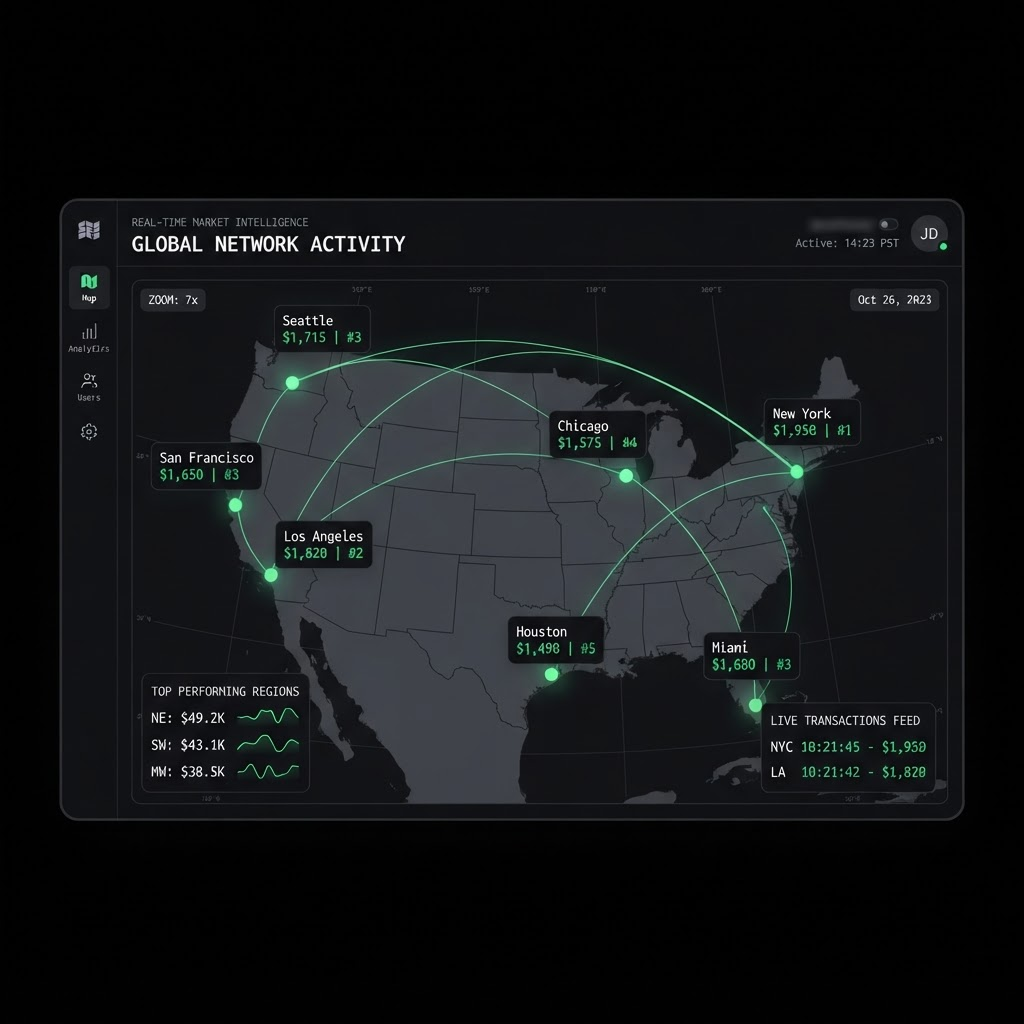
Search "wireless earbuds" on Amazon from a zip code in Los Angeles, and then search the exact same keyword from a zip code in Miami two seconds later. You will not get the same page. Different ranks. Different Buy Box winner on some ASINs. Different delivery promise. Sometimes a different price.
Most people scraping Amazon never see this, because most scrapers make every request from one place — usually whatever data center IP their proxy pool happened to assign that day. They get one version of Amazon and assume it is the only version.
It is not. Amazon renders search results and product pages differently depending on the location tied to the request. This post walks through exactly what changes, city by city, and how a geo-targeted scraping API captures it.
Why Amazon localizes what it shows you
Amazon's whole logistics model is built around getting a package to a shopper as fast and as cheaply as possible from the nearest fulfillment center with stock. That means the platform needs to know where a request is coming from before it can answer basic questions like "is this in stock," "what does shipping cost," and "who wins the Buy Box for this listing right now."
Three things get computed per-location on every request:
- Organic and sponsored rank. Inventory position, seller proximity to the buyer, and regional demand all factor into how Amazon's ranking algorithm orders a SERP.
- Buy Box winner. When multiple sellers carry the same ASIN, Amazon picks a winner per request based on landed price (price + shipping) and delivery speed to that specific zip code — not a single global winner.
- Price and delivery promise. Sellers can price differently by region, and Amazon's delivery estimate is always calculated from a specific fulfillment center to a specific address.
If your scraper does not carry a location, Amazon still has to render something — so it defaults to whatever it infers from the proxy IP. That is rarely the location your customers, or your competitors' customers, are actually shopping from.
A real city-by-city demonstration
Here is what a single keyword search or ASIN lookup can return differently across six real U.S. cities, using our geo-targeted search and product endpoints:
| City (Zip Code) | What typically shifts |
|---|---|
| New York, NY (10001) | Dense fulfillment coverage — fastest delivery promises, more same-day eligible listings surface higher. |
| Los Angeles, CA (90001) | West Coast sellers with regional stock climb rank; East Coast-only sellers can drop off page one entirely. |
| Chicago, IL (60601) | Buy Box winner frequently differs from both coasts due to central-warehouse proximity advantages. |
| Miami, FL (33101) | Slower delivery windows on some ASINs shift sponsored placement mix; regional pricing tests show up here first. |
| Houston, TX (77002) | Independent from both coasts — a useful "control" zip code for isolating true national rank from regional noise. |
| Seattle, WA (98101) | Amazon's home turf — some listings show delivery promises here that do not exist anywhere else in the country. |
Run the same ASIN or keyword across all six and you typically see: a different Buy Box winner in at least one or two cities, organic rank shifting by several positions between coasts, and at least one listing whose sponsored placement disappears entirely outside its regional stock radius.
None of that is visible from a single scrape run out of one data center. It only shows up when the request itself carries a location.
State-level patterns worth tracking
Zoom out from individual cities and state-level patterns emerge that matter for pricing and compliance work specifically:
- MAP violations cluster regionally. A reseller undercutting minimum advertised price in one state and staying compliant in others is common — and invisible unless you are checking price by state, not just once.
- Rank volatility differs by state population density. High-density states (NY, CA, IL) show more day-to-day rank churn than lower-density states, simply because more competing sellers have regional stock there.
- Delivery-speed-driven Buy Box swings are seasonal. During peak shipping periods, Buy Box winners in less-connected states change more often as fulfillment centers rebalance inventory.
If you are only tracking from one location, you cannot see any of this. You need the same query run from multiple zip codes on a schedule, with the results tagged by location so you can actually compare them.
How to scrape Amazon with geo-targeting correctly
Doing this reliably at scale comes down to a few requirements:
- Zip code as a first-class request parameter. Not a proxy pool you hope is regionally accurate — an explicit zip code you set on every search and product request.
- Any zip code, on demand. Not a fixed set of five pre-configured locations. If a competitor is testing pricing in a specific market, you need to be able to check that exact zip code, not the nearest one your provider happened to support.
- Separate mobile and desktop results. Location changes the SERP; device changes it again. The two need to be tracked independently, not blended into one number.
- Consistent zip code per session. If you are comparing rank over time, the location has to be locked for that tracked keyword — flipping locations between runs makes rank history meaningless.
This is exactly what our /search and /product endpoints are built for — every request accepts a zip code, returns the SERP or product page rendered for that location, and locks it per tracked keyword so your historical rank data stays comparable over time.
Who actually needs this
Geo-targeted scraping is not a novelty feature. It matters most for:
- Brands running regional PPC strategies who need to know their real rank in the markets they are actually bidding into, not a national average.
- MAP enforcement teams checking whether a reseller is undercutting price in specific states without getting caught nationally.
- Sellers optimizing Buy Box win rate who need to see which regions they are losing in — and to whom — before they can fix it.
- Agencies benchmarking client performance against competitors in the client's actual delivery radius, not wherever a generic scraper's IP happened to be.
If your rank tracker, price monitor, or Buy Box alert has never told you which zip code it is checking from, it has been showing you one arbitrary slice of Amazon and calling it the truth. Geo-targeting is how you find out what your customers are actually seeing — city by city, state by state.