The best marketers in the world all do one thing: they make you feel an emotion. In the TikTok era of e-commerce, the creators worth partnering with are the ones who make their audience feel something — preferably something positive. The problem is that views and likes can't tell you what a creator's audience feels. Their comment section can. With enough comment data you can measure the emotions a creator evokes — trust, desire, awe, curiosity vs. frustration, confusion, scepticism — and choose the creators whose audiences feel the right things. Here's how to score creators by emotion with the Asgard TikTok API.
Quick answer
- The principle: great marketing makes people feel an emotion — so the emotion a creator's audience feels is the real signal.
- Where it lives: in the comment section, not the view count.
- What to measure: an emotion profile per creator — trust, desire, awe, curiosity, FOMO, plus the negatives (frustration, confusion, scepticism).
- The decision: partner with creators who make audiences feel positive, high-intent emotions; avoid the ones who evoke negativity.
- Beyond e-commerce: it works for any industry that cares how an audience feels about a message.
Why emotion is the signal that matters
- Emotion drives purchase. People buy on feeling and justify with logic — a creator who sparks desire or trust moves product.
- Views don't carry sentiment. A million views tells you nothing about whether the audience felt inspired or annoyed.
- Positive emotion compounds into brand equity. Trust and gratitude around a creator rub off on the brand they promote.
- Negative emotion is a hidden risk. A viral creator whose audience feels scepticism or frustration can damage the brands they touch.
What an emotion profile looks like
Run enough of a creator's comment sections through sentiment analysis and each one gets a dominant-emotion profile — a ranked breakdown of what their audience feels, backed by representative quotes.
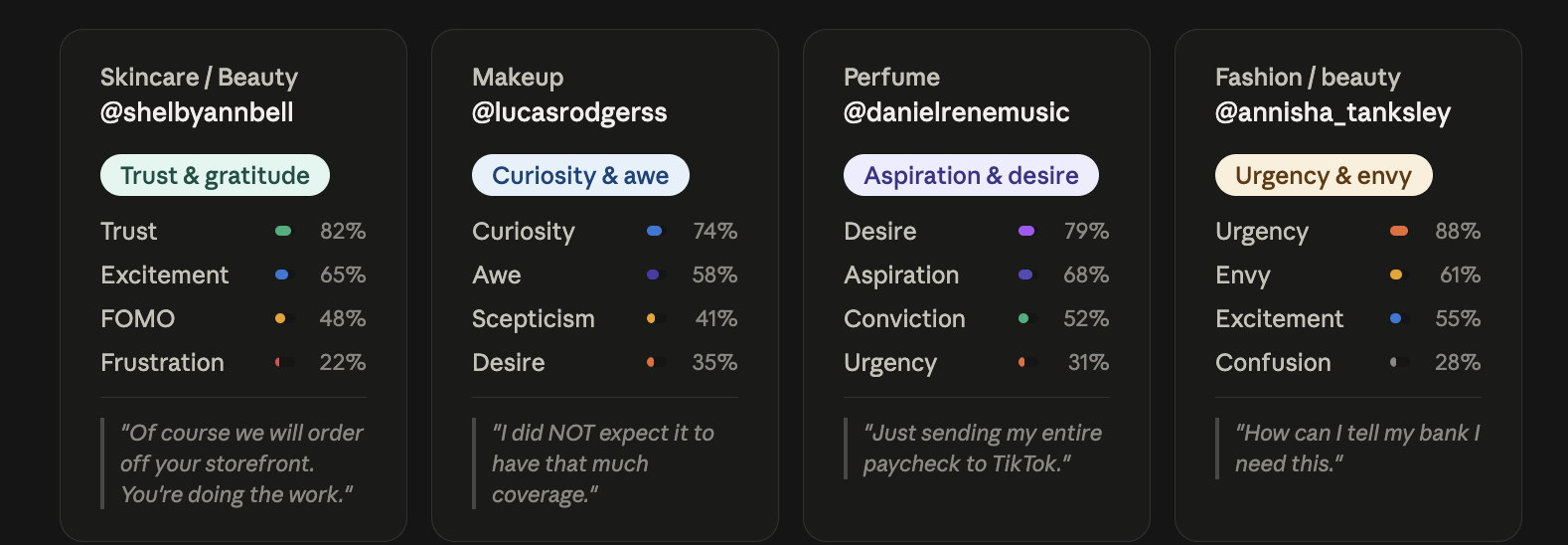
The same product category can evoke completely different emotional mixes depending on the creator:
- Trust & gratitude — "Of course we will order off your storefront. You're doing the work." A loyal, high-trust audience.
- Curiosity & awe — "I did NOT expect it to have that much coverage." Discovery-driven, with some healthy scepticism.
- Aspiration & desire — "Just sending my entire paycheck to TikTok." Pure want.
- Urgency & envy — "How can I tell my bank I need this." High-intent, impulse-leaning.
How to read the profiles
- Favor positive, high-intent emotions. Desire, trust, aspiration, and awe convert and build brand love.
- Watch the negatives. High scepticism, frustration, or confusion is a warning — the audience doesn't believe or doesn't get it.
- Match emotion to your goal. Want fast sales? Look for urgency and desire. Building a premium brand? Prioritize trust and aspiration over impulse.
- Mind the mix, not one number. A little scepticism among strong curiosity is fine; scepticism as the dominant emotion is not.
How to do it at scale with Asgard
- Collect the creator's videos. Use the profile, hashtag, and search endpoints to gather relevant content.
- Scrape the comment sections. Pull every comment with the comments endpoint.
- Run sentiment & emotion analysis. Classify comments into emotion categories and compute a weighted profile per creator.
- Rank by emotional fit. Score creators against the emotions your brand wants to evoke.
- Partner with the right feeling. Choose creators whose audiences feel positive, on-brand emotions — and skip the ones who spread negativity.
Frequently asked questions
Can you measure the emotion a creator's audience feels? Yes — by analyzing enough of their comment sections you can build a dominant-emotion profile (trust, desire, awe, frustration, etc.) per creator. The Asgard TikTok API pulls the comments so you can run sentiment analysis at scale.
Which emotions should brands look for? Positive, high-intent emotions — desire, trust, aspiration, awe, curiosity. Match the mix to your goal: urgency and desire for fast sales, trust and aspiration for a premium brand. Avoid creators whose audiences feel mostly scepticism, frustration, or confusion.
Does this only work for e-commerce? No. Emotion-based creator assessment works for any industry that cares how its audience feels about a message — it's a general way to evaluate creators, not just sellers.
Why not just use views and likes? Reach metrics don't carry sentiment — a viral video can leave its audience annoyed or unconvinced. Emotion profiling reads how people actually feel, which is what drives purchases and brand equity.
Related reading
- Stop picking TikTok creators by views, likes, and shares
- Rank TikTok creators by comment intent — and catch conversion leaks
- The objection goldmine hiding in TikTok comments
Score creators by the emotions they create:
☞ Asgard TikTok API · docs at asgardata.com