In today's competitive Amazon marketplace, prominent organic ranking matters more than ever heading into 2026. High ad costs and fierce competition mean agencies must find smarter ways to boost product visibility without burning the budget on PPC. The good news: by mastering how Amazon's search algorithm actually works — and by tapping the external-traffic channels that now feed it — agencies can grow client sales sustainably. This guide distills the organic-ranking playbook into clear best practices any Amazon agency can action, and shows where measurement with the Asgard Amazon API and the upcoming Asgard TikTok API turns strategy into a trackable system.
Quick answer
- Organic rank is the cheapest traffic there is — every organic click costs $0 versus $1–$5+ for PPC.
- Amazon ranks on revenue, not units. Sales velocity on a specific keyword is the strongest ranking signal.
- External traffic now matters. The A10-era algorithm rewards off-Amazon traffic that converts — and TikTok is the biggest source.
- You can't improve what you don't measure. Track keyword rank (organic + sponsored, by zip, mobile + web) with the Asgard rank tracker.
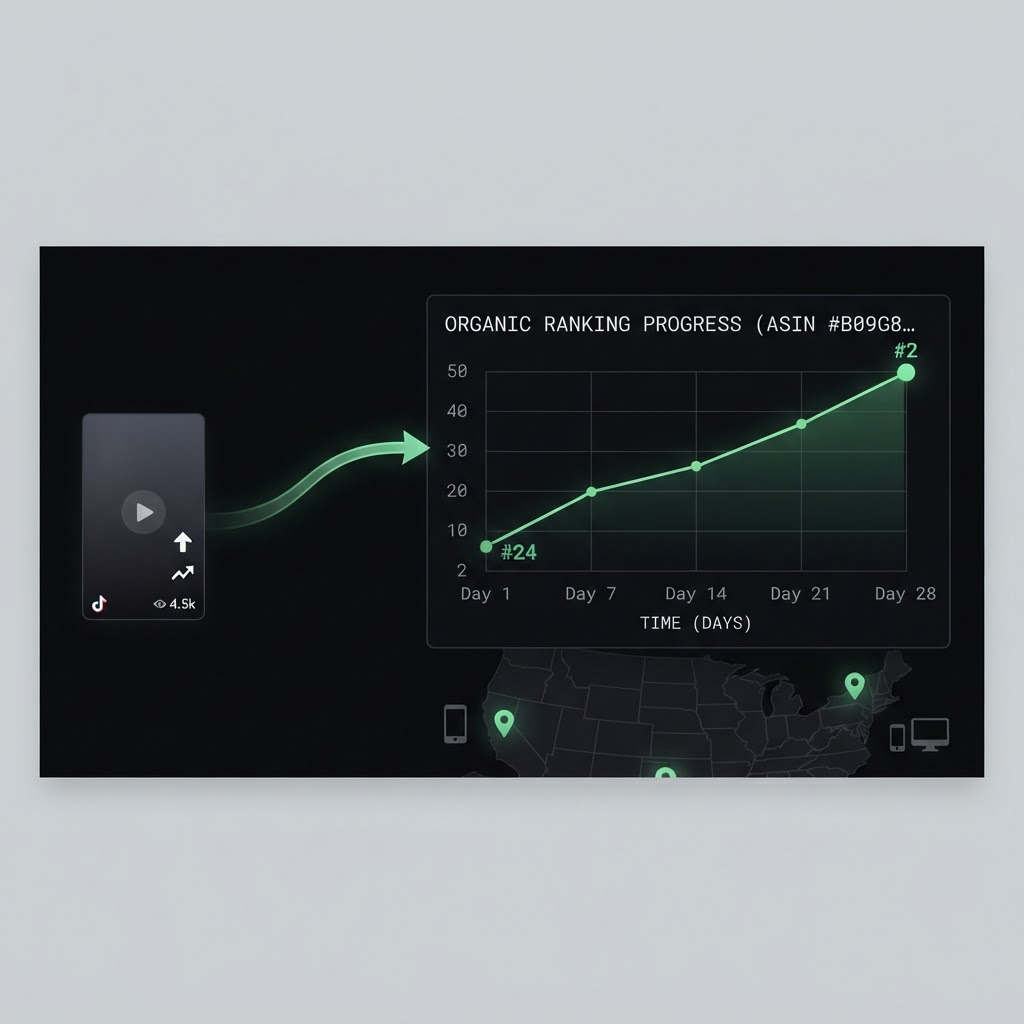
- Connect the two ends: the TikTok API shows the demand forming, the Amazon API shows the rank it produces.
Why organic ranking is top of mind in 2026
For sellers and the agencies that support them, organic ranking is where a product appears in search results without paying for the placement. A top organic spot for a relevant keyword is essentially free, recurring visibility. Every organic click costs $0, while a PPC click on a competitive keyword can run $1 to $5 or more. Higher organic rankings translate directly into better margins and scalability.
During Q4 and major events, Amazon sees traffic surges — more shoppers, but also more competition and higher ad costs. Organic visibility is the counterbalance that lets your product be seen by thousands of shoppers without a matching spike in ad spend. And unlike ads, organic rank keeps selling after the investment: if your ad budget runs dry, your organic listing is still working.
How Amazon's algorithm rewards sales — not just keywords
Amazon is, at its core, a revenue-and-satisfaction engine: the products that make Amazon the most money and keep customers happiest rise to the top. Crucially, Amazon ranks products on a keyword by the revenue generated, not merely units sold. A $60 product can outrank a $20 product on the same keyword with a third of the sales, because the search term produced the same revenue.
Relevance, click-through rate, conversion rate, and reviews all feed the model, but the outcome Amazon wants is to show the product most likely to be purchased. This is why random views don't move rank — only views that convert to sales do. It's also why PPC can indirectly lift organic rank: ads that drive keyword purchases build the sales momentum the algorithm rewards. The takeaway for agencies: Amazon SEO can't be gamed with keywords alone. You have to optimize the full experience — listing, price, product quality, reviews — so the sales signal is real.
External traffic is the 2026 differentiator (and where TikTok comes in)
The biggest shift from the old A9 thinking to the A10 era is how much Amazon rewards external traffic that converts. Sending qualified off-Amazon shoppers who buy sends a powerful relevance signal for that keyword — and in 2026, the single largest source of that traffic is TikTok. Amazon itself recognized this: its short-lived, TikTok-style Inspire feed was an attempt to capture exactly this discovery-to-purchase behavior. Inspire is gone, but the shopper habit it chased is bigger than ever — it just lives on TikTok.
This is the halo effect: a creator video creates demand, and that demand converts on Amazon, lifting the product's rank for the keywords shoppers use. For agencies, that turns TikTok from a "brand awareness" line item into a direct organic-rank lever — if you can measure it.
That's where the upcoming Asgard TikTok API fits. It lets you watch the demand form before it hits Amazon:
- Spot the videos driving demand in your category via the search and hashtag endpoints, and track their engagement velocity.
- Read buying intent in the comments — "where's the link", "just ordered on Amazon" — to catch a halo wave as it starts.
- Mine creator-coined keywords that shoppers will type into Amazon search next, so you can index for them before competitors do.
Then you validate the lift on the Amazon side (below). The TikTok API shows the cause; the Amazon rank tracker shows the effect.
Keyword research: the groundwork for ranking
Every organic strategy starts with structured keyword research, segmented into three tiers:
- Core "bullseye" terms. The keywords that precisely describe the product (e.g. "cork yoga mat", "non-slip yoga mat"). These represent your most qualified traffic and must appear naturally in the title and bullets — and be tracked closely in a rank tracker.
- Expanded, broadly relevant terms. Adjacent searches that capture shoppers with a need but no specific product in mind ("workout mat", "yoga accessories"). Great for lower-bid PPC; if they convert, organic rank follows.
- Seasonal and contextual terms. Gift and occasion keywords that surge at specific times ("fitness gift", "New Year workout gear"). Rotate them in and out with the calendar.
In 2026, add a fourth input: emerging terms from social. Creators invent language — nicknames, use-cases — and shoppers search those exact phrases on Amazon. Pull them from TikTok comments and captions with the TikTok API and you'll be indexing for tomorrow's high-volume keywords today.
Optimizing listings to convert
Traffic is only half the battle — the listing decides whether a click becomes a sale, and conversion is what feeds rank:
- The main image is the hook. It has to earn the click among dozens of similar thumbnails — clear product, fills the frame, strong lighting, differentiated where the category allows. Higher CTR leads to more sales and, over time, better rank.
- Title & bullets with keywords, front-loaded. Put the most important terms early, but keep it readable for humans. Use bullets to pair secondary keywords with real benefits.
- A+ content and all image slots. Use every image slot and A+ modules to answer objections and tell the brand story. It lifts conversion even though A+ text isn't indexed.
- Price and reviews. Competitive pricing and a strong star rating are conversion multipliers. A wave of bad reviews drops sales — and rank follows.
Treat optimization as continuous: A/B test images and copy, measure, iterate. Small conversion lifts compound across thousands of shoppers into meaningful rank gains.
Balancing paid and organic
Paid and organic aren't mutually exclusive — the ideal is to own both slots on page one. Appearing as a sponsored result and an organic result doubles your real estate and reinforces trust. Use PPC to launch products or push keywords where you're just outside page one organically, then dial back bids as organic rank takes hold. Ads also generate conversion data per keyword: a term that converts well on ads is a term worth pushing organically.
Proactive monitoring: rank tracking and competitor analysis
Organic ranking is never set-and-forget — it demands continuous measurement. This is the half most agencies under-instrument, and where the Asgard Amazon API does the heavy lifting:
- Track every target keyword for organic and sponsored position with the Asgard rank tracker, and alert on big moves — a drop after a stockout, or a break into the top 10.
- Lock location to a real zip code. Organic ranks vary by zip; Asgard supports unlimited US zips and holds the same location across pulls, so your trend reflects real change, not location noise.
- Watch mobile vs web separately. The same ASIN can rank #3 on desktop and page 2 on mobile — where most Amazon traffic is. Asgard returns both SERP views.
- Correlate cause and effect. Line up a TikTok spike (from the TikTok API) against the Amazon rank move that follows, and you can prove which content actually drove rank — and forecast the next wave.
- Analyze competitors and protect stock/price. Monitor competitor pricing, reviews, and keyword coverage; and never go out of stock, which is one of the fastest ways to lose a hard-won rank.
Frequently asked questions
What is the most important Amazon organic ranking factor in 2026? Sales velocity on the specific keyword — Amazon ranks by revenue generated for a search term, not units sold. Everything else (images, copy, price, reviews) matters because it drives the conversions that create that signal.
Does external traffic from TikTok really improve Amazon rank? Yes — when it converts. Off-Amazon traffic that turns into keyword purchases builds sales momentum the A10-era algorithm rewards. This halo effect is why TikTok is now a direct organic-rank lever, not just brand awareness. Track the demand with the upcoming Asgard TikTok API.
How do agencies track Amazon organic rank accurately? Use the Asgard Amazon API to monitor organic and sponsored positions per keyword, locked to a specific US zip code and split by mobile vs desktop, on a schedule — so rank changes reflect real movement rather than location or device noise.
How do I connect TikTok activity to Amazon rank? Line up the timelines: capture the TikTok demand spike and buying-intent comments with the TikTok API, then measure the Amazon rank move that follows with the Amazon API. The lag between them is your predictive window.
Related reading
- How to detect the halo effect with a TikTok scraper + an Amazon scraper
- Free Tool: Amazon Keyword Rank Checker
- The best Rainforest API alternatives in 2026 (honest comparison)
Turn organic ranking into a measurable system:
☞ Free Amazon Keyword Rank Tracker · Amazon API + TikTok API · docs at asgardata.com