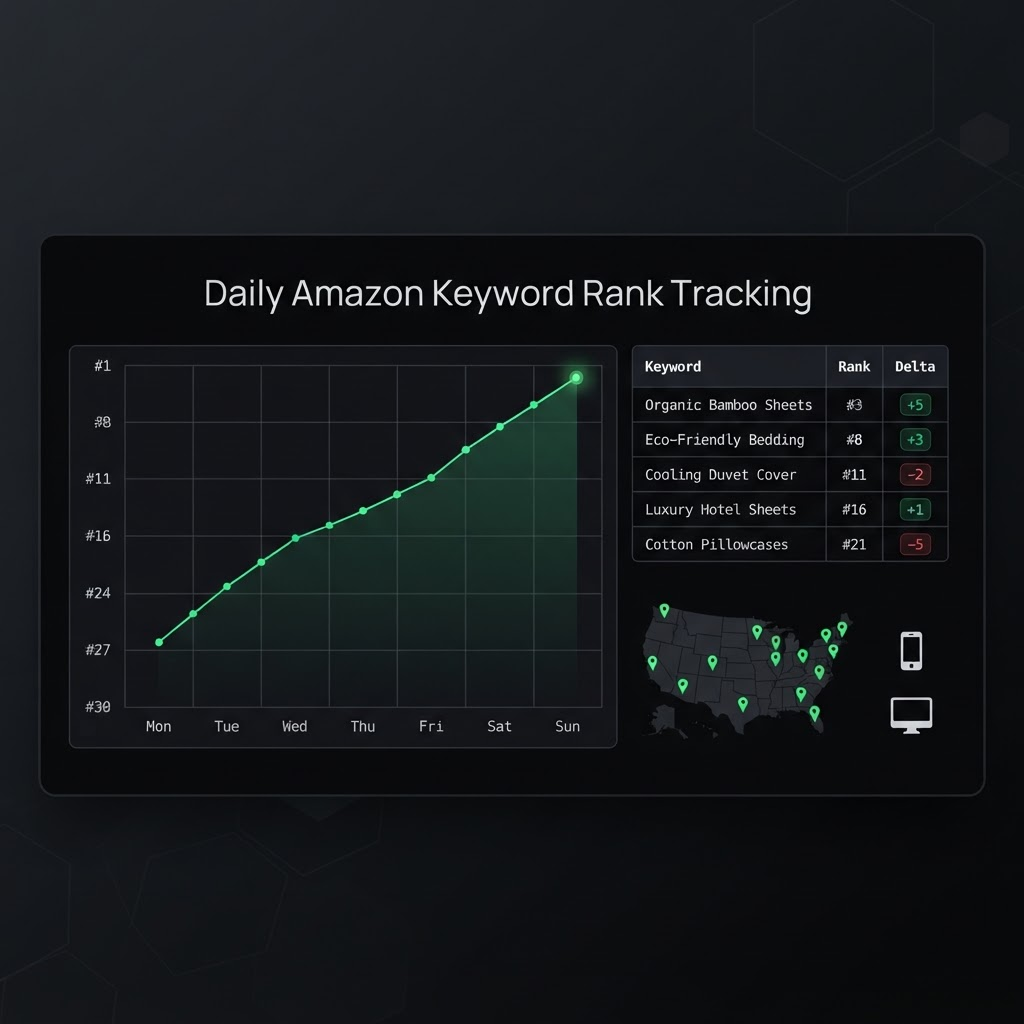
Amazon keyword rankings are not static — they move every single day. A product that sits at #4 for its main keyword this morning can slide to #11 by tomorrow after a competitor's sales spike, a stockout, a price change, or an ad campaign going live. That's why daily keyword rank tracking is the baseline for any serious Amazon seller or agency in 2026: a weekly snapshot hides the moves that actually cost you sales. This guide covers why daily tracking matters, how to start free, and how to automate it by zip code and device with the Asgard Amazon API.
Quick answer
- Ranks change daily, so weekly or monthly checks miss the drops that matter until it's too late to react.
- Daily tracking gives you a trend line, not a guess — you see cause and effect within 24 hours of any change.
- Start free with the Asgard keyword rank tracker — no signup, real-time data.
- Automate at scale with the Asgard Amazon API: schedule daily pulls, locked to a zip code, split by mobile vs desktop.
Why daily — not weekly — rank tracking wins
Most rank trackers default to weekly or on-demand checks, and that gap is where money leaks out. Amazon's algorithm re-ranks continuously based on sales velocity, conversion rate, inventory, and ad activity — all of which change day to day. If you only check once a week, a three-day slide from #3 to #15 looks like a single mysterious drop, and you've already lost most of a week's organic traffic before you notice.
Daily tracking flips that. When you capture rank every 24 hours you get a continuous trend line, so you can:
- Catch drops fast. A sudden fall often signals a stockout, a hijacked listing, a suppressed image, or a competitor promotion — all things you want to fix today, not next week.
- Measure cause and effect. Change a title, price, or main image and you'll see the rank response within a day or two, cleanly attributed instead of buried in a weekly average.
- Prove ROI. Agencies can show clients the exact day a listing optimization or PPC push moved the needle.
- Time your PPC. Watch how organic rank reacts as ad-driven sales build, and pull back bids once organic holds.
What "accurate" daily tracking actually requires
Tracking daily is only useful if each daily data point is measured the same way. Three things quietly ruin a daily trend line if you get them wrong:
| Requirement | Why it matters for daily tracking |
|---|---|
| Consistent location (zip code) | Organic ranks vary by zip. If today's pull comes from Chicago and tomorrow's from Dallas, your "daily change" is just location noise. Lock the same zip every day. |
| Same device view | Mobile and desktop SERPs differ. Compare mobile-to-mobile and desktop-to-desktop, or the daily delta is meaningless. |
| Organic vs sponsored separation | A day's "rank" should track true organic position, not get inflated by a sponsored placement that appears one day and not the next. |
| Same time of day | Run the pull at a consistent hour so intra-day fluctuations don't masquerade as daily trends. |
The Asgard Amazon API handles the first three directly: every request is locked to the exact US zip you choose (unlimited zips), returns both mobile and web SERP views, and separates organic from sponsored placements with the highest sponsored-capture rate of any Amazon scraper.
Start free: the browser rank tracker
The fastest way to begin is the free Amazon Keyword Rank Tracker — no account, no download. Enter your product's ASIN and a keyword, pick a US zip code, and it returns your current organic rank, sponsored rank, and page position on both mobile and desktop. Run it each day for your core keywords and log the numbers, and you've got a manual daily tracker for a handful of ASINs in minutes.
For a few products this is enough. Once you're tracking dozens of keywords across many ASINs, you'll want to automate.
Automate daily tracking with the Asgard API
The same data behind the free tool is available programmatically. Schedule a job once a day (a cron task, a serverless function, whatever you prefer), hit the Amazon search endpoint for each ASIN–keyword pair, find your organic position, and store it with a timestamp. Over days and weeks that table becomes your rank-history trend line.
// Runs once daily per ASIN + keyword, locked to a zip code
const res = await fetch(
  "https://api.asgardata.com/amazon/search?" +
  new URLSearchParams({ keyword: "stainless steel water bottle", country: "US", zip: "10001" }),
  { headers: { Authorization: "Bearer YOUR_API_KEY" } }
);

const data = await res.json();
const organicRank = data.results
  .filter((r) => !r.sponsored)
  .findIndex((r) => r.asin === "B09XY12345") + 1;

await db.rankHistory.insert({
  asin: "B09XY12345",
  keyword: "stainless steel water bottle",
  zip: "10001",
  rank: organicRank || null, // null = not on page 1
  checkedAt: new Date().toISOString(),
});
Run the same job for the mobile view, alert yourself when a keyword moves more than a few positions overnight, and you have a production-grade daily rank tracker across your entire catalog.
How to read your daily trend
- Steady climb: your optimization or sales velocity is working — keep going.
- Sudden overnight drop: check inventory, buy box, listing suppression, and competitor promotions first.
- Sawtooth (up-down-up): usually normal daily volatility; look at the multi-day average, not any single day.
- Slow decline: a competitor is likely gaining sales velocity on that term — revisit price, images, and PPC.
Frequently asked questions
How often do Amazon keyword rankings change? Continuously. Amazon re-ranks based on sales velocity, conversion, inventory, and ads, so positions can shift multiple times a day. Daily tracking is the practical cadence to catch meaningful moves without chasing intra-day noise.
Is daily rank tracking better than real-time? For most sellers, yes. Real-time checks are useful for spot diagnosis, but a consistent once-daily pull (same zip, same device, same hour) produces a clean trend line that's easier to act on than a noisy real-time feed.
Can I track daily rankings for free? Yes — use the free Asgard keyword rank tracker and log your core keywords each day. For many ASINs or automated scheduling, use the Asgard Amazon API.
Why does my rank differ by location and device? Amazon personalizes results by delivery location and serves different layouts on mobile vs desktop. For daily tracking to be accurate, lock the same zip code and compare the same device view each day — both supported by the Asgard API.
Related reading
- Free Tool: Amazon Keyword Rank Checker
- Amazon SEO keyword research: a complete 2026 guide
- Amazon organic ranking in 2026: agency strategies that work
Track your keywords daily — free tool, or automate with the API:
☞ Free Amazon Keyword Rank Tracker · Amazon API · docs at asgardata.com